
Digital Twins In Pharma
Q1. Could you start by giving us a brief overview of your professional background, particularly focusing on your expertise in the industry?
I have spent over 15 years at the intersection of computational science, pharmaceutical manufacturing, and regulatory strategy. My career has spanned roles at global pharma and medtech organizations — including senior scientific positions at a top five pharmaceutical company and principal engineering roles at leading medical device firms — where I built and deployed predictive modeling platforms that directly informed product development, process scale-up, and regulatory submissions.
My technical foundation is in mechanistic modeling: computational fluid dynamics, finite element analysis, and reduced-order models that bridge first-principles physics with AI-driven surrogate layers. At a major pharma company, I led the predictive modeling program for oral solid-dose manufacturing, where we cut the experimental design-of-experiments workload by 50% and reduced process-optimization timelines by 35% — translating into over $2 million in validated cost savings.
What differentiates my perspective is the regulatory credibility dimension. I established verification and validation standards aligned with ASME V&V 40 across enterprise modeling programs, directly connecting simulation outputs to regulatory submission evidence. This experience led me to build Sigmatwin, a regulatory risk prediction platform that maps pharmaceutical submission content against historical patterns in FDA Complete Response Letters, Warning Letters, and inspection observations. The platform operates across biologics, small molecules, and medical devices, covering multiple regulatory jurisdictions.
In short, I have built digital twins that run on physics engines and on regulatory intelligence — and I have seen firsthand how both create measurable business value when deployed correctly.
Q2. Which industry is showing the highest “Willingness to Pay” for digital twins right now, and is it driven by cost-cutting or regulatory pressure?
Pharma and biotech currently show the highest willingness to pay, and the honest answer is that it is driven by both, but regulatory pressure is the sharper catalyst.
Here is why: a failed batch in pharmaceutical manufacturing can cost $500K to $2M, depending on the molecule and scale. That is a cost-cutting argument. But a Complete Response Letter from the FDA — which delays market entry by 12 to 24 months — can destroy $50 million to $200 million in projected revenue. That is a regulatory survival argument. When you frame digital twin adoption in terms of avoided CRL risk rather than just batch yield improvement, the willingness to pay shifts dramatically.
From my experience across pharma, medtech, and healthcare, the companies writing the largest checks for digital twin platforms are those that have already been burned by a regulatory setback — a 483 observation, a refuse-to-file, or a CRL — and are now investing in predictive infrastructure to ensure it does not happen again. The cost-cutting ROI gets the CFO’s attention, but the regulatory risk story gets the CEO’s signature.
Beyond pharma, medical device companies are a strong second. The EU MDR transition has created urgent demand for computational modeling evidence, particularly under ASME V&V 40 frameworks, where digital twins can substitute for physical testing in regulatory submissions. I have seen device companies reduce validation timelines by 30–40% through model-based evidence packages.
Q3. Can Digital Twins significantly reduce the Carbon Footprint of Pharma manufacturing, and is this currently a “Decision-Grade” metric for the C-Suite?
Digital twins can reduce carbon footprint but let me be direct: it is not yet a decision-grade metric for most pharma C-suites. It is a second-order benefit that comes along for the ride when you optimize for what actually drives decisions — yield, cost, and compliance.
Here is the mechanism. When a digital twin enables you to replace 50% of your physical design-of-experiments with in-silico simulations — as we did for oral solid-dose manufacturing — you eliminate raw material consumption, energy use, solvent waste, and failed batches. Each avoided batch run at commercial scale can eliminate 5 to 15 tonnes of CO₂-equivalent emissions, depending on the process. Scale that across a portfolio, and the numbers become substantial.
But in boardroom conversations, I have never seen carbon reduction alone justify a digital twin investment. What I have seen is sustainability teams leveraging the data after the fact to report against ESG targets. The C-suite approves the digital twin for cost and speed. The sustainability officer uses the same data to show reduced environmental impact in the annual report.
My prediction: this will change within 3 to 5 years as Scope 3 reporting requirements tighten in the EU and as FDA and EMA increasingly reference sustainable manufacturing in guidance documents. But today, if you are pitching a digital twin purely on carbon footprint, you are pitching to the wrong audience in the room.
Q4. How critical is the Digital Twin for the industry’s move toward Continuous Manufacturing? Is it even possible to run a continuous line without a real-time shadow?
You cannot run a continuous manufacturing line at commercial scale without a real-time digital twin. It is not optional infrastructure — it is the control system itself.
In traditional batch manufacturing, you can afford to run a batch, test it offline, and make corrections on the next run. The feedback loop is slow but tolerable. In continuous manufacturing, material flows through the system constantly. If your granulation moisture drifts by 2% or your blend uniformity shifts, you do not have the luxury of waiting for offline analytics. By the time the lab results come back, you have produced thousands of units of potentially nonconforming product.
The digital twin serves as the real-time shadow that predicts process behaviour 30 to 60 seconds ahead of the physical process. It ingests PAT sensor data — NIR spectroscopy, particle size analyzers, in-line dissolution probes — and runs reduced-order models that flag deviations before they propagate downstream. This is not theoretical; this is how the most advanced continuous manufacturing lines in pharma operate today.
From a regulatory perspective, this is equally critical. FDA’s guidance on continuous manufacturing explicitly expects real-time release testing and advanced process control. A digital twin provides the computational backbone for both. Without it, you are essentially asking the FDA to trust a process that you yourself cannot monitor in real time. That is not a conversation any regulatory affairs team wants to have.
What I would add from my experience building these systems: the physics layer matters enormously. Pure data-driven ML models fail in continuous manufacturing because they cannot extrapolate beyond their training data. When a new raw material lot introduces unexpected variability, a physics-based model with AI acceleration — the kind of hybrid architecture we built using reduced-order models and NVIDIA Physics-NeMo surrogates — can still predict behaviour accurately because it understands the underlying transport phenomena. A purely statistical model just throws up its hands.
Q5. Moving from lab to commercial manufacturing often results in yield loss. How much revenue is saved by using a Digital Twin to predict Process Scale-Up failures before the first batch is run?
This is where I can speak from direct experience. In the programs I led for oral solid dose scale-up, we used predictive CFD and mechanistic models to identify process parameter ranges that would fail at commercial scale — before running a single batch. The result was a 35% reduction in process optimization time and a 50% reduction in the number of experimental runs required.
Let me translate that into revenue terms. A single failed commercial-scale batch for a small molecule product cost $500K to $2M in raw materials, manufacturing time, and investigation overhead. For biologics, the range is $5M to $20M per batch, depending on the molecule. In a typical scale-up campaign, companies might run 5 to 15 experimental batches before locking commercial process parameters. If a digital twin eliminates half of those, you are looking at $2.5M to $15M in direct savings for small molecules and $25M to $150M for biologics — per product, per scale-up campaign.
But the larger revenue impact is time-to-market. Every month of delay in the commercial launch of a blockbuster drug represents $50M to $200M in lost revenue. If a digital twin compresses your scale-up timeline by even 3 to 6 months — which is conservative based on the 35% timeline reductions we demonstrated — the revenue protection is measured in hundreds of millions.
The companies that get this right treat scale-up modelling as a pre-investment, not a cost centre. The ones that do not learn the same lesson repeatedly — at $2M per failed batch.
Q6. Can you quantify the reduction in “Wet Lab” spend when a project successfully integrates a physics-based AI model?
From the programs I have led: a well-integrated physics-based AI model reduces wet lab experimentation by 35–50%. That is not a projection — that is measured performance across multiple product scale-up programs.
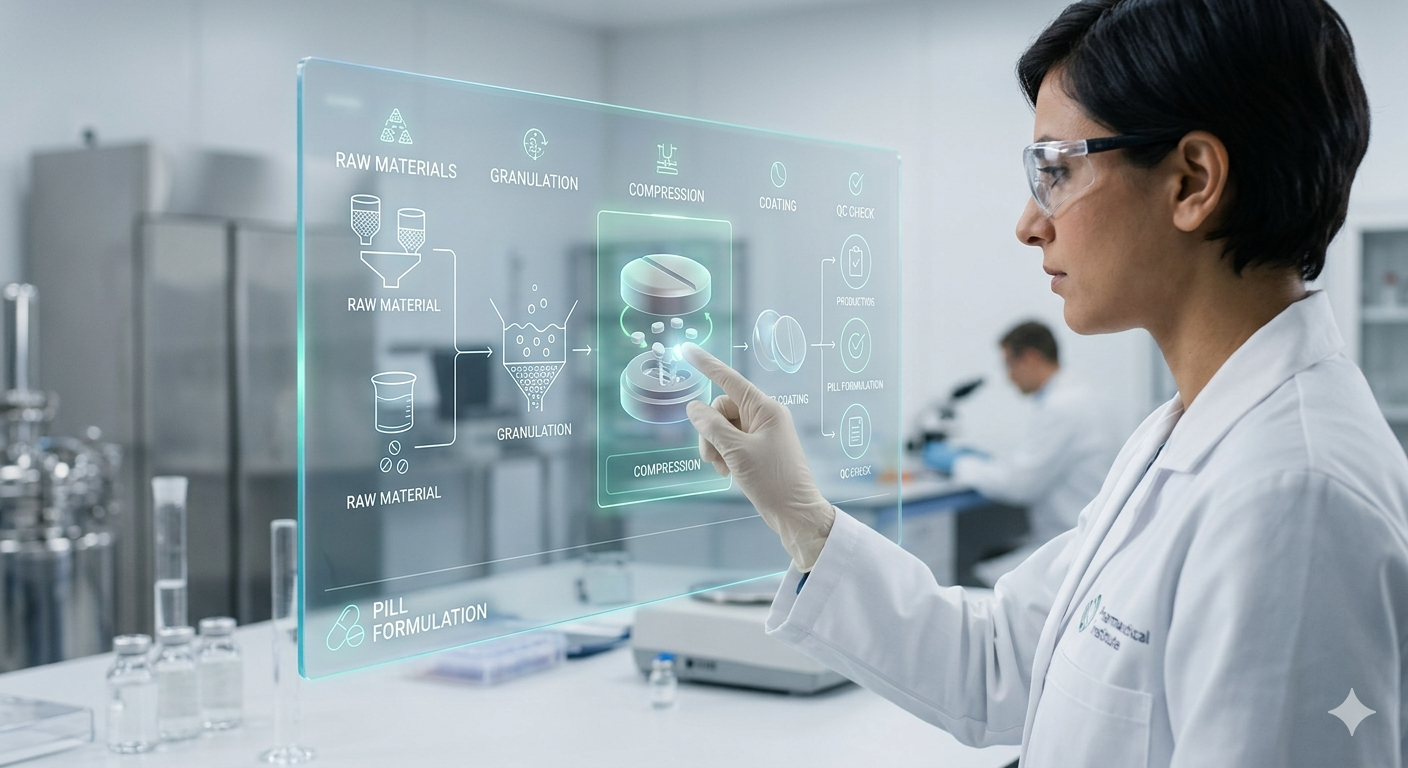
The mechanism is straightforward. Traditional pharmaceutical process development relies heavily on design-of-experiments approaches — systematically varying process parameters and measuring outcomes. A full-factorial DOE for a tablet manufacturing process with 6 parameters and 3 levels requires 729 experimental runs. A physics-based model with AI surrogate layers can screen that parameter space computationally, identify the critical 20–30% of parameter combinations that actually matter, and reduce the physical DOE to 150–250 runs. That is a 50–65% reduction in lab time, materials, and analyst hours.
In dollar terms, wet lab spend for process development on a single product program typically ranges from $3M to $8M for small molecules and $10M to $30M for biologics. A 35–50% reduction translates to $1M–$4M saved per small molecule program and $3.5M–$15M per biologics program.
The key qualifier is “successfully integrates.” Not every physics model delivers this. The models that work are those built on genuine mechanistic understanding — fluid dynamics, heat transfer, mass transport, particle mechanics — and then accelerated with AI surrogates for real-time use. Pure curve-fitting ML models trained on historical batch data give you a 10–15% reduction at best, because they cannot generalize to new formulations or new equipment configurations. The physics layer enables you to predict in regions where you have no experimental data, which is precisely the scenario in scale-up.
Q7. If you were an investor looking at companies within the space, what critical question would you pose to their senior management?
One question: “Show me the last three times your digital twin told you something your process engineers did not already know — and what decision you made differently because of it.”
This question separates real digital twin deployments from expensive dashboards. The market is full of companies that have built digital twins that visualize data beautifully but have never actually changed a decision. If the senior management team cannot point to specific instances where the digital twin generated a non-obvious insight that led to a different manufacturing parameter, a different submission strategy, or a different investment allocation, then what they have is a monitoring tool, not a decision-support platform.
The follow-up questions I would ask: What is your model credibility framework? Are you validated against ASME V&V 40 or an equivalent standard? If you are selling into regulated industries and cannot demonstrate verification, validation, and uncertainty quantification to regulatory standards, you are one FDA audit away from your entire value proposition collapsing.
And finally: What is your moat? Physics-based digital twins require deep domain expertise in the specific manufacturing process being modelled. If a company claims to have a “general-purpose digital twin platform” that works across all pharmaceutical processes, I would be skeptical. The companies that win in this space are those with deep, validated models for specific unit operations — granulation, coating, lyophilization, fermentation — not horizontal platform plays with thin domain knowledge.
The same principle applies to regulatory intelligence. At Sigmatwin, we built a platform that maps submission content against historical FDA deficiency patterns across 290+ Complete Response Letters. The moat is not the technology — it is the curated deficiency taxonomy and the domain expertise required to interpret regulatory language. Any investor should be asking: where does the proprietary knowledge live, and how defensible is it?
The views and opinions expressed herein are the author’s own and do not represent the views of Knowledge Ridge, FactSet, or any current or former employer. All financial figures cited are based on the author’s professional experience and publicly available industry benchmarks.
Comments
No comments yet. Be the first to comment!