
Future Of Ropeway Engineering
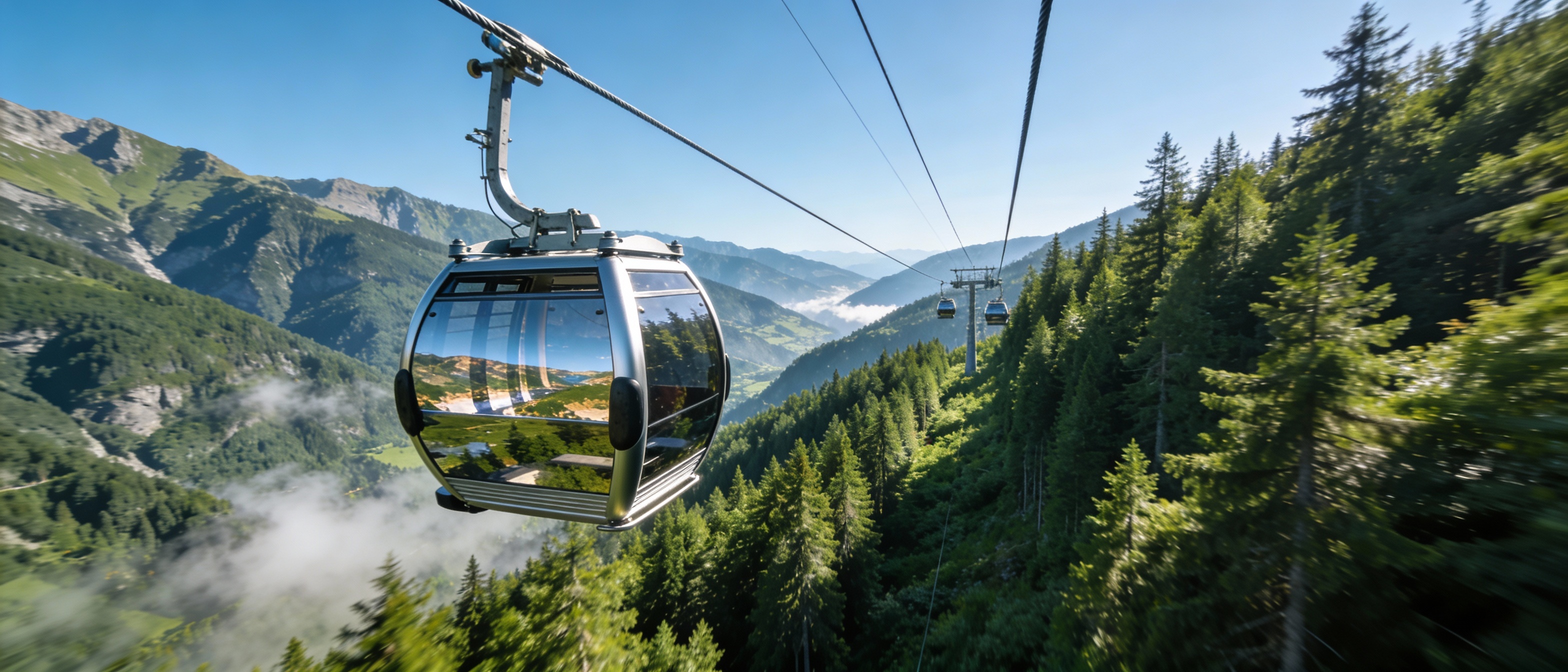
Explore how smart engineering and IoT are reshaping the ropeway industry. With regulatory changes and innovative business models ahead, discover unique, data-driven opportunities in this evolving sector.
Q1. Could you start by giving us a brief overview of your professional background, particularly focusing on your expertise in the industry?
Over the past 25+ years, I have held various roles across the entire value chain in the ropeway and mechanical engineering industries – from design and engineering through production and logistics to digitalization and strategic development.
For the majority of my career, I worked for a global market leader in ropeway systems. There, I was responsible, among other things, for:
- Building and optimising production and assembly lines
- Designing production and logistics concepts
- Introducing Industry 4.0 solutions on the shopfloor
- Transferring new technologies from pilot projects into stable series production
Today I work as an independent industrial consultant and as the owner of a state-certified engineering consultancy (“Ingenieurbüro”) in Austria. My main focus areas are:
- Lifecycle-optimised ropeway systems
- Digital shopfloor concepts (MES, IoT, data integration)
- Knowledge graphs and digital twins connecting engineering, operations and service
In short: I operate at the intersection of mechanics, operational safety and digitalization – with a strong focus on economic feasibility, series scalability and innovation. I am very concerned about how established, historically grown companies and their products can remain competitive in the future, and how their products and processes need to adapt to become future-proof. My current focus is on heavy machinery and freight wagon transport on rail.
Q2. How do smart systems reduce cable car lifecycle costs for different terrains/gradients amid recent material inflation?
Smart systems address several cost drivers at once – especially relevant across different terrains and profiles (steep, long, urban, wind-exposed):
Predictive maintenance instead of reactive maintenance
- Condition monitoring of grips, sheave assemblies, gearboxes, bearings and brakes
- Maintenance based on actual stress and condition instead of fixed time intervals
Fewer unplanned downtimes, higher availability, longer component life.
Energy optimisation via drive dynamics and load profiles
- Speed, acceleration and driving strategy are adapted to wind, temperature, load and altitude profile
- Recuperation and load management reduce energy costs
A massive lever, especially for steep and energy-intensive installations.
Smarter use of reserves and safety factors
- More precise measurements of loads, vibrations, and stresses allow more targeted use of existing reserves
- This often enables leaner inspection strategies without compromising safety
Topography-specific optimisation
- In challenging terrain (long spans, tall towers, wind-prone sections), smart systems help
- To better understand rope forces, vibration behaviour and tower loads in operation
- To derive improvements for operations, maintenance and future projects
Mitigating the impact of material inflation
- As steel, copper and other materials become more expensive, each additional year of lifetime and every avoided disruption becomes economically more relevant
- Smart systems shift costs from CAPEX (material, over-dimensioning) towards intelligent OPEX management (data, algorithms, services)
Bottom line: Smart systems pay off most where topography, utilisation or climate drive wear and tear – in other words, in exactly those demanding installations that are economically most critical.
Q3. Which regional regulations have most impacted cable car project economics in recent years?
In recent years, the following regulatory areas have had the largest impact on the economics of ropeway projects:
Safety and Machinery Regulations (EU / CEN / national rules)
- EU Machinery Directive / new EU Machinery Regulation and ropeway-specific standards (e.g. EN standards for ropeways, safety, control systems)
- They increase documentation and proof requirements and influence redundancy concepts and the complexity of safety technology
Building, environmental and spatial planning law (especially in Alpine countries and urban regions)
- Landscape protection, noise limits, environmental impact, avalanche/debris flow/landslide/wind risks
- These requirements massively affect route selection, number of towers, foundations and construction methods – and therefore directly CAPEX
Public transport regulation & Procurement law
- In urban projects, additional requirements often apply, such as accessibility, passenger information, integration into public transport, fare systems, etc.
- Public tenders and procurement procedures play a major role in timelines and cost structures
Energy and Climate Regulation
- Regulations and incentive schemes for renewable energy, CO₂ pricing and energy efficiency
- They shift the focus more strongly towards energy-optimised drive technology and can positively influence business cases for modernisations
In practice, the strongest economic impact usually arises from the combination of stricter safety and environmental standards plus more complex permitting processes – this extends project durations and increases planning and engineering effort.
Q4. Which Industry 4.0 tools scaled prototypes to series production fastest in your 25+ years, delivering efficiency gains, and what sub-segment shows the widest adoption dispersion?
Over my 25+ years of experience, the following tools have proven most effective in taking solutions from prototype to robust series production:
End-to-end 3D CAD + PDM/PLM
- Parametric models, variant logic, clean bills of material
- Reduces errors between engineering, purchasing, manufacturing and assembly
Digital Factory Planning and Simulation
- Material flow simulation, layout simulation, cycle time analysis
- Very effective for optimising new production processes for ropeway components before physical implementation
MES / digital shopfloor
- Real-time feedback, traceability, shopfloor-level work instructions
- Essential for stabilising prototype processes and making them repeatable in series production
Standardised Data Models & Knowledge Management
- Consistent naming, clean item master data, clear rules and templates
- This may sound unspectacular, but it is often the key enabler for digital tools to truly scale
The widest spread in implementation levels can be observed in the following sub-segments:
Suppliers and smaller manufacturers
Some are highly digital and tightly integrated, while others still work almost entirely paper-based.
Welding and steel structures vs. precision machining
In high-precision machining, digital processes are often more mature; in classic steel and welded structures, there is still substantial potential
Service and After-sales
Here, the range spans from excellently integrated digital service platforms to purely phone- and paper-based processes.
Q5. From knowledge graph/digital twin integrations, what service revenue streams beat traditional hardware margins in your experience?
Where digital twins and knowledge graphs are applied in a meaningful way, service models emerge that often achieve higher margins than pure hardware business:
Availability and Performance-based contracts
- Payment based on availability, passenger throughput or operating hours instead of only on spare parts
- The operator effectively buys “safety and availability”, while the manufacturer leverages its data competence.
Condition monitoring & remote diagnostics as a service
- Continuous condition monitoring, alarm filtering, actionable recommendations
- Integrating operational data, maintenance history and engineering knowledge creates real added value
Optimisation packages (energy & operations optimisation)
- Analysis of operating profiles, operating strategies, start/stop cycles, and energy consumption
- Continuous improvement based on a digital twin – billable as an annual service contract
Engineering updates & Retrofit Recommendations
- The digital twin serves as a basis for targeted modernisation (component changes, software updates, modifications)
- Revenue from engineering services in combination with hardware retrofits
Knowledge-graph-based support systems
- Intelligent assistance for operators, maintenance teams and inspectors (e.g. guided troubleshooting, context-aware instructions)
- Monetisable as licence models or support flat rates
The crucial point: once data, models and expertise are intelligently connected, value creation increasingly shifts towards continuous lifecycle support – with correspondingly attractive margins.
Q6. What IoT maintenance ROI multiples separated top performers, and what sensor KPIs drove it?
In well-designed projects, I have typically seen ROI multiples in the range of 2x to 5x over several years – meaning that investments in sensors, connectivity and analytics pay back in a relatively short time, primarily through:
- Reduced unplanned downtime
- Better planning of major overhauls
- Lower spare parts consumption through condition-based maintenance
- Higher availability in peak periods (which is economically particularly valuable)
The sensor KPIs with the strongest impact were:
Availability and Downtime metrics
- Unplanned downtime minutes per season/year
- MTBF (Mean Time Between Failures) of critical components
Condition indicators of critical components
- Vibration and temperature data of bearings, gearboxes and motors
- Grip forces and opening/closing behaviour of grips
- Rope sag, sheave loading and rope temperature in critical areas
Load and Usage Profiles
- Number of trips, load spectra, acceleration profiles
- Number of braking events/emergency stops, brake temperature profiles
Energy metrics
- kWh per operating hour or per passenger-kilometre
- Peak loads and their reduction through optimised driving strategies
Top performers were never the ones with the largest volume of data, but those that measured a few carefully selected, meaningful KPIs cleanly – and consistently translated them into operational decisions.
Q7. If you were an investor looking at companies within the space, what critical question would you pose to their senior management?
If I were an investor looking at companies in this space, my one central question to senior management would be:
“How exactly will you be making your money in ten years’ time – still primarily from hardware, or from recurring services built on your installed base and operational data? And what concrete steps are you taking today to get there?”
This very quickly reveals:
- Whether leadership thinks mainly in terms of project business (CAPEX) or in lifecycle terms (OPEX)
- Whether digital twin, IoT and knowledge graphs are just buzzwords or have been translated into a clear business model
- Whether the company is culturally ready to take long-term responsibility for availability and performance
Comments
No comments yet. Be the first to comment!