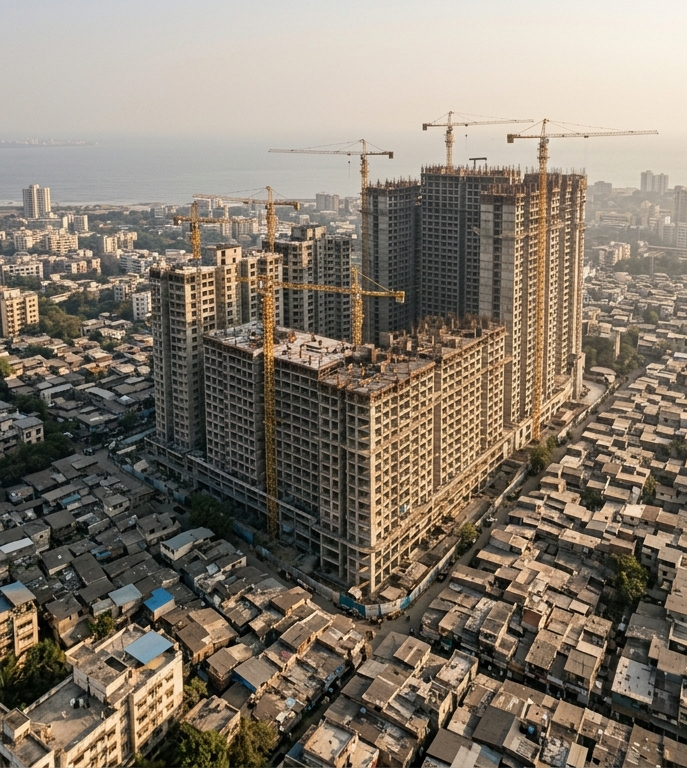
Redevelopment VS. Greenfield in Mumbai’s Real Estate
Q1. Could you start by giving us a brief overview of your professional background, particularly focusing on your expertise in the industry?
I am a Business Under-Graduate & a Post-Graduate MBA from premium institutes in the UK, with 20+ solid and proven years of total work experience globally in Management Consulting and 13+ years in Mumbai Real Estate Industry specialising in Financial Analysis, Project Modelling, Management Strategy, Corporate and Project Planning, New Business Development, Leadership, Team Building and Management, Strategic Business Planning, Sales and Marketing Strategy, Business Negotiations and Vendor Management; with strong focus on directly impacting the Commercial ROI & operational + strategic efficiency for the company.
In my current role with Rustomjee Group, I head the Business Development function involving the acquisition of land for development under both Outright and Joint Development models across the MMR, as well as all kinds of Redevelopment Proposals, including Private Societies, MHADA Societies, Cess Properties, and SRA Layouts.
In my past roles, I have headed Redevelopment and Land Acquisition for Mahindra Lifespace Developers Ltd., held P&L responsibilities at Starwing Developers Pvt. Ltd., and headed New Business Development in the Mumbai region for the Real Estate Division of Shapoorji Pallonji & Co. Ltd.
Direct Involvement
- Provide strategic leadership across Business Development, Land Acquisition, and Redevelopment with hands-on execution in both greenfield and brownfield real estate projects
- Work closely with Promoters, Investors, and CXOs to identify and structure high-value opportunities, driving growth across emerging and established markets
- Lead market expansion strategies, financial modeling, due diligence, and partnership negotiations for multi-million-dollar real estate ventures
- Deeply involved in management restructuring, building high-performing teams, and optimizing reporting and operational protocols for scalability
- Regularly contributes to industry education and mentoring as a visiting faculty, advancing professional development in real estate strategy and redevelopment
- Play a key role in regulatory interpretation and compliance, applying DCPR and UDCPR frameworks to enhance feasibility and execution outcomes
- Recognized for creating a strong development pipeline, balancing profitability, risk, and long-term brand positioning.
Q2. How do you foresee the consolidation of smaller developers affecting the supply chain and the pricing power of large players?
With the apparent consolidation of smaller developers, cash flows in the market increase as volumes and bulk orders rise, yet margins for various participants involved balance out due to economies of scale. Since the larger developers will always lean towards lower margins and higher volumes, the smaller developers will offer quicker turnaround and better margins. All in all, the market response to consolidation amongst developers will also similarly affect suppliers and supply chain partners. With better regulation of pricing and quality required for improving the end product, the industry will benefit overall in the long-term sustainability.
While smaller developers will always have a role to play, larger developers will always focus on prime markets and volumes. The common factor for success for both sets of developers will be to stay true to your customers by delivering quality and maintaining trust.
Q3. Beyond land cost, what are the three primary operational KPIs that differ when moving from Mumbai’s high-density redevelopment to greenfield expansion in Pune?
Consolidated construction costs, sales velocity/volume/margins, and local market competition are among the top KPIs influencing the decision to explore a greenfield in Pune versus a brownfield in Mumbai.
Q4. How does the yield profile and velocity of sales in the Tier-2 cities compare to a mid-range project in the MMR under the current UDCPR?
With land scarcity and proximity to developed civil infrastructure and other related opportunities, the sales velocity is comparatively higher in the MMR than in Tier-2 cities. At the same time, transactions are less structured and differently enabled outside the MMR, with lower yields in Tier-II driven by regulatory factors, market demand, and sales margins.
Q5. How has the recent shift in cluster redevelopment policies changed the feasibility of South Mumbai projects for tier-1 developers?
The latest cluster redevelopment policy has already benefited central and suburban locations, with the South Mumbai proposals lagging due to restrictions within the CRZ boundaries. Additionally, larger clusters are more amenable in the central and suburban corridors compared to the southern micro-markets. Moreover, the existing carpet sizes are larger in the South than in the North, further hampering techno-commercial offers for existing residents and occupants in the South. With the expectations of educated South-based Members leaving no margins on the table, the opening of redevelopment in the CRZ regions has increased the potential stock-to-market in the South multi-fold, thereby adversely affecting the project feasibility of South Mumbai projects.
Q6. In the current interest rate environment, what specific deal structures are you seeing that successfully hedge against the long-term liquidity traps typical of MMR land parcels?
Partnerships are the way forward. Be it with landowners (societies or individuals), Financial Institutions (like Banks, IBCs, Funds, FDIs), or with service providers (like building contractors, especially for Societies opting for self-redevelopment, or developers exploring barter systems or seeking strata sale partners). Creative ways to reduce borrowings and overheads are the way forward, since the cost of finance remains the biggest potential factor affecting any real estate project. Amongst multiple options available, the joint development (revenue-sharing JDA) method is the purest and offers distinct responsibilities and benefits to both parties, allowing each to focus on their strengths without creating unnecessary liabilities for the other.
Q7. If you were an investor looking at companies within the space, what critical question would you pose to their senior management?
Long-term growth prospects / potential, as well as real-time operating cash flows, will be the key areas of focus for investors. Brand image, market trust, and sales velocity will also be important factors in the decision-making process. Overall, a balanced portfolio to hedge against market downturns or trends is also necessary to instill confidence in investors and all relevant stakeholders alike. Lastly, a good team at the helm to steer through uncertainties and ride out macro factors is required for long-term stability and sustainability.
Comments
No comments yet. Be the first to comment!