
The Future of Industrial Water Management
Q1. Could you start by giving us a brief overview of your professional background, particularly focusing on your expertise in the industry?
I have more than 10.5 years of experience in industrial water and wastewater treatment, mainly in design, project execution, commissioning, troubleshooting, operations support, and the execution of ETP, STP, UF, MBR, RO, EDI, DM Plant, and ZLD systems. I have worked with companies such as Arvind Ltd., Ion Exchange, and Membrane Group India, and I am currently working at LNK Green Energy as Sr. Manager – Water Engineering. Right now, I am handling end-to-end activities, including design, engineering, execution, and commissioning for a solar cell manufacturing project. Most of my experience is practical, site-based work where we deal with real operational challenges during the startup and stabilization of plants.
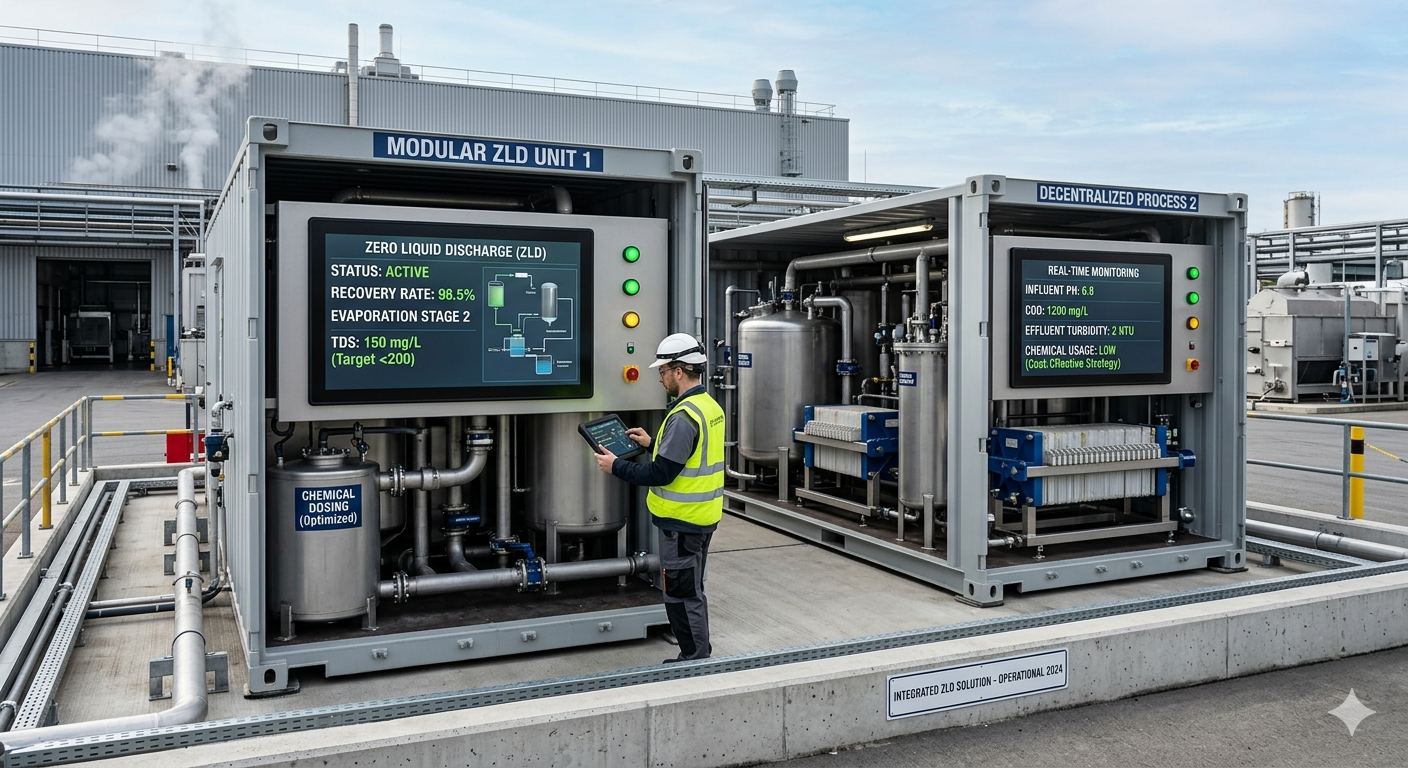
Q2. Are you observing a structural shift among industrial clients toward procuring decentralized, pre-fabricated, and containerized modular treatment systems over traditional, large-scale centralized concrete treatment facilities?
Yes, definitely. Nowadays, many clients prefer modular and containerized systems because installation time is less, civil work is reduced, and future expansion becomes easier. Especially in industries where production changes frequently or timelines are very aggressive, modular systems are becoming more popular. Traditional concrete systems are still preferred for very large capacities, but overall, the trend is clearly moving toward skid-mounted and modular solutions.
Q3. What are the unique execution and fouling challenges you have noticed when working within a legacy plant's existing concrete footprint?
The biggest challenges are space limitations and a mismatch between old design assumptions and current operating conditions. Many old plants were not designed for modern membrane systems or higher recovery targets. Because of uneven flow distribution, dead zones, poor piping layouts, and insufficient equalization, fouling issues increase significantly. During retrofitting, even small piping modifications become difficult because everything is already fixed in concrete.
Q4. When industrial manufacturing plants transition to capital-intensive Zero Liquid Discharge (ZLD) systems, where do the most frequent execution gaps occur during start-up?
Most gaps arise from an improper understanding of actual feed variation. On paper, feed quality appears stable, but in practice, the load keeps fluctuating. Many times, equalization systems are undersized, chemical dosing philosophy is not optimized, and automation interlocks are not properly tuned during startup. Another major issue is coordination among biological systems, RO systems, and evaporator sections, as all systems are interdependent in ZLD.
Q5. On the ground at actual commissioning sites, how reliable are these digital sensor networks (TOC, pH, pressure transmitters) under harsh industrial effluent conditions? Are operators trusting automated backwashes?
The sensors are reliable if proper maintenance and calibration are done regularly, but in harsh industrial wastewater conditions, fouling and scaling on sensors are very common. pH sensors especially require frequent cleaning and calibration. Operators still prefer manual verification because field conditions are not always ideal. Automated backwash systems are improving, but many operators still monitor them manually during critical operations because one failed backwash can impact the entire downstream system.
Q6. Are industrial clients strictly locked into purchasing premium, vendor-specified specialty chemicals to protect their equipment warranties, or is there a noticeable field trend toward adopting generic, third-party chemical formulations?
Initially, while the plant is under warranty, clients mostly use OEM-recommended chemicals due to warranty concerns. But after the plant stabilizes, many industries start evaluating third-party alternatives to reduce operational costs. In the field, we are seeing a clear trend toward generic formulations, especially for CIP chemicals and antiscalants, provided that performance is properly validated. Cost optimization is becoming a major focus area for industries.
Q7. If you were an investor looking at companies within the space, what critical question would you pose to their senior management?
There are many questions I would ask along with reviewing their reports, but the major question would be the number of installed plants and how much of their capacity is actually running successfully after one or two years of commissioning. Many companies are strong in sales and design presentations, but long-term operational stability is the real benchmark in this industry. I would also ask how they handle after-sales technical support and troubleshooting processes, as these directly impact long-term client trust. Along with that, I would also evaluate their growth trend, including the last three years’ financial performance, current order book, and their targets for the next two years.
Need an expert in this space?
Talk to an Industry Expert
Knowledge Ridge connects decision-makers with carefully vetted subject matter experts for one-on-one calls, research sprints, and advisory engagements — across 11 sectors and 163 sub-industries globally.
Comments
No comments yet. Be the first to comment!