
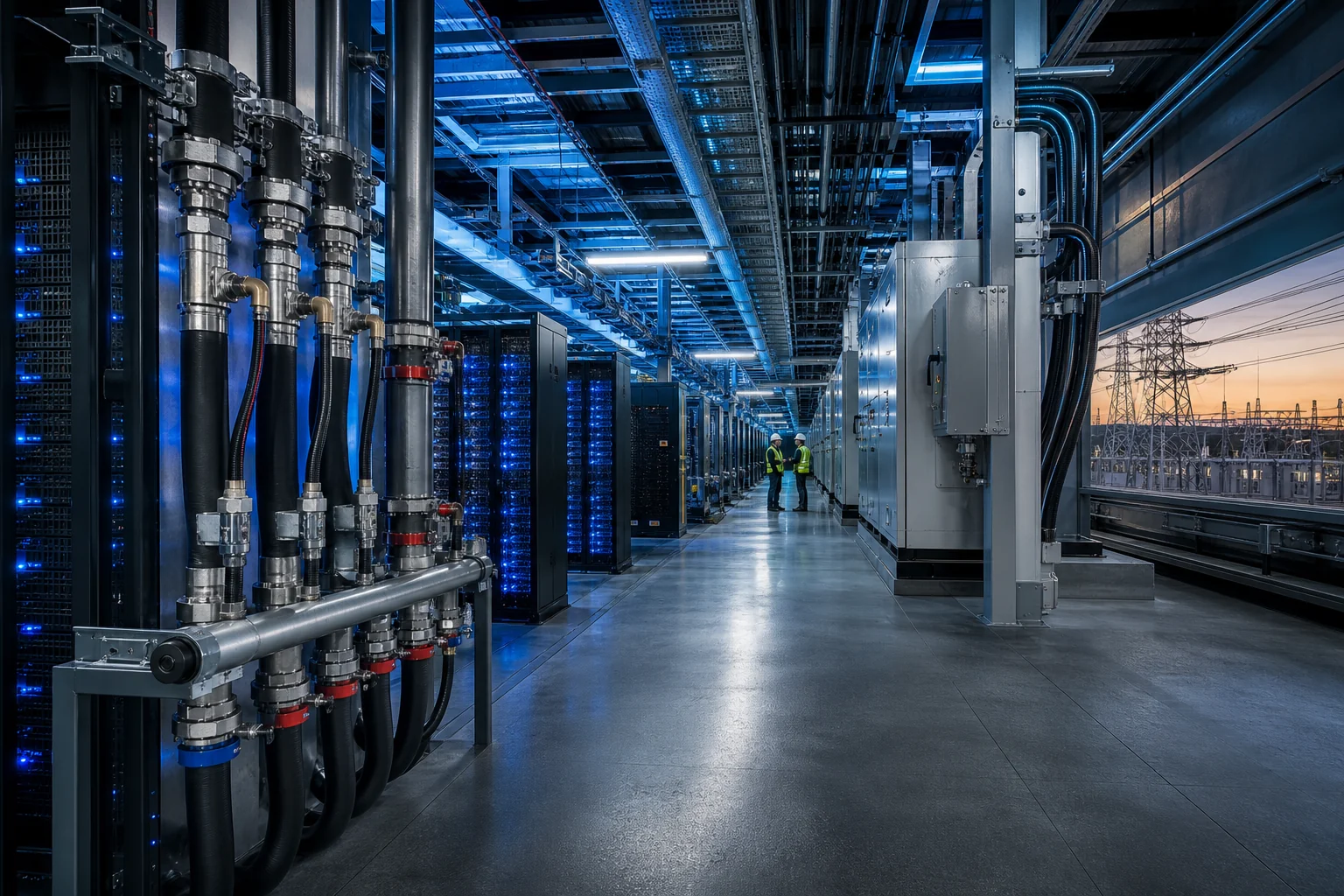
The Constraint Isn't Compute. It's Everything Around It.
AI infrastructure investment has become one of the defining capital-allocation stories of the decade. But investors evaluating data centre operators, hyperscaler suppliers and adjacent infrastructure businesses are discovering that the binding constraints are not GPUs - they are grid connections, cooling capacity, water rights and permitting timelines. The diligence frameworks that matter now are as much about energy infrastructure and local regulation as they are about technology. Getting them right requires practitioners who have actually built, powered and operated these facilities. Read Knowledge Ridge's expert view on power transition and renewable growth.
Engage Infrastructure & Power Grid Experts for Mandate Diligence
Grid Connection: The Multi-Year Queue That Reshapes Every Model
In data centre development underwriting, grid interconnection timing can be a major source of IRR impairment. Across tier-one markets, interconnection queues are severely backlogged, and preliminary utility assurances can change under technical review. The timeline gap between a developer's projected energisation date and true grid synchronisation directly erodes asset yield and delays cash-flow generation. Direct dialogue with former utility transmission engineers and regional grid planners provides investment committees with grounded benchmarking of queue reality. Explore Knowledge Ridge's energy and infrastructure expert network.
Speak with a Grid Interconnection Specialist through Knowledge Ridge
Cooling, Water, and the PUE Arms Race
AI workloads have pushed rack densities to levels that make traditional air cooling uneconomic in some deployments, accelerating the shift to liquid and hybrid cooling architectures. For investors, this creates two distinct diligence questions. First, technology risk: is the operator's cooling roadmap genuinely deliverable at the claimed Power Usage Effectiveness (PUE), or is it aspiration dressed as specification? Second, resource risk: water-intensive cooling strategies face tightening scrutiny in water-stressed regions, and permitting regimes are evolving. Expert conversations with data centre operations leads, mechanical engineers and environmental permitting specialists convert both questions from assumptions into evidence. See Knowledge Ridge's IT infrastructure case studies.
Design a Cooling Technology Validation Survey
The Supplier Ecosystem: Where the Second-Order Opportunities Sit
The expansion of AI data infrastructure is driving asymmetrical value creation across the critical supply chain - specifically in transformers, high-voltage switchgear and liquid-cooling components. However, extreme lead-time volatility introduces execution risk to project completion schedules. Identifying which operators hold secured, tier-one equipment allocations versus those reliant on unverified vendor promises requires targeted primary research across procurement heads, OEM commercial leads and EPC contractors. Read Knowledge Ridge's expert perspective on semiconductor and hardware supply chains.
Map the Data Centre Supplier Landscape with Knowledge Ridge
Permitting and Site Selection: The Local Constraint Layer
A technically credible design can still fail as an investment if the site cannot secure power, water, construction approvals or community support on the modelled timeline. Diligence should separate permits already granted from applications, assumptions and preliminary discussions. It should also test whether local planning rules, environmental requirements, noise limits, backup-generation restrictions and fibre-route dependencies have been reflected in the schedule and contingency budget. Former permitting officials, utility planners, data centre developers and local engineering advisers can help investment teams benchmark realistic timelines across candidate sites and identify which constraints are transferable, which are location-specific and which could make a project uneconomic before major capex is committed.
Primary Intelligence for a Market Moving at AI Speed
Every quarter, the economics of AI infrastructure shift - new chip generations change power and cooling requirements, hyperscaler capex guidance moves markets, and regulatory regimes evolve. Static research cannot keep pace. The investors building durable positions in this sector are those maintaining continuous access to the engineers, operators, utility specialists and permitting experts living these changes daily. Knowledge Ridge's stated network reach spans 80+ countries and 163 sub-industries, supported by a 99% engagement success rate. Explore Knowledge Ridge's expert term engagements for ongoing coverage.
Frequently Asked Questions
Why does grid interconnection matter in data centre diligence?
Connection timing affects when a facility can become operational and generate cash flow. Investors should test queue position, utility assumptions, available capacity and the conditions attached to an energisation date.
Which experts can validate a data centre cooling strategy?
Data centre operations leaders, mechanical engineers, cooling-equipment specialists and environmental permitting professionals can test technology readiness, PUE assumptions, water exposure and maintenance requirements.
How can investors assess AI infrastructure supplier risk?
Primary research with procurement heads, equipment manufacturers and EPC contractors can validate allocation, lead times, vendor concentration, substitution options and project-schedule exposure.
Partner with Knowledge Ridge for AI Infrastructure Diligence