
AI-Driven Telecom Value Creation

Q1. Could you start by giving us a brief overview of your professional background, particularly focusing on your expertise in the industry?
For over three decades, I’ve worked at the intersection of telecommunications, digital distribution, Mobile Money /fintech, and enterprise technology. My journey has been a combination of being a developer, presales, business development, sales, consulting, solution architecture, and product strategy, which has given me the opportunity to work closely with mobile network operators, technology vendors, enterprise customers, and digital transformation teams across multiple geographies viz. Indian subcontinent, APAC, MMEA.A significant part of my career has been focused on telecom distribution ecosystems—prepaid recharge, voucher management, dealer and retailer management, mobile financial services, commission management, and the increasingly important convergence of telecom and digital financial services. Over the years, I’ve also worked extensively with analytics platforms, AI-driven decision intelligence, and enterprise data modernization initiatives.
Today, as an independent consultant, I help organizations bridge the gap between technology possibilities and measurable business outcomes. Increasingly, that means helping businesses harness AI not as a standalone technology, but as a strategic business capability. I work closely with leadership teams to simplify complex challenges, identify new revenue opportunities, and build digital ecosystems that are scalable, intelligent, and commercially sustainable.
Much of my work today involves enabling AI-led business transformation. This includes designing AI-powered business process automation, implementing Agentic AI solutions that can autonomously execute multi-step business workflows, deploying intelligent voice and chat agents for customer care and service operations, and helping organizations automate sales, marketing, and content generation at scale. I also advise enterprises on leveraging enterprise data to build AI-driven decision support systems, predictive analytics, and operational intelligence that improve speed, efficiency, and customer experience.
My philosophy has always remained the same: technology by itself is never the differentiator. Real competitive advantage comes from thoughtfully combining people, processes, data, and AI to solve business problems, improve decision-making, and create measurable, sustainable value. As AI continues to reshape industries, the organizations that succeed will embed intelligence into every business function rather than treating AI as a separate initiative.
Q2. What structural shifts do you believe will define the next phase of the telecom and fintech ecosystem, and where do you see the greatest opportunities for value creation?
The industry is moving from isolated digital products and application platforms to interconnected digital ecosystems.
Historically, telecom operators sold connectivity, fintechs offered payments, banks managed financial products, and technology companies built the infrastructure. Those boundaries are rapidly disappearing. For example, quick commerce and e-commerce are quietly becoming fintech players like Amazon Pay, Blinkit, and Zomato. The next decade will be defined by collaboration rather than competition.
I see five structural shifts shaping the future.
First, data will become more valuable than transactions. Organizations that can transform fragmented operational data into real-time business intelligence will outperform those that process transactions faster.
Second, AI will move from being a productivity tool to becoming an operational decision engine. The winners will not necessarily have the most sophisticated AI models, but the cleanest, most connected enterprise data.
Third, telecom distribution is evolving into a broader digital commerce platform. Retailers who once sold airtime are increasingly becoming access points for payments, insurance, lending, government services, and digital identity. I see massive scope in agentifying the distribution chain; this doesn't mean replacing humans, but making each role in the distribution chain 20X by giving them multiple agents to increase efficiency. For example, while the FOS (foot-on-street) is riding his bike, he voices agents to call the retailers he is going to visit and make appointments in his own voice, do the sensing, collect competitive intelligence, etc. Possibilities are unlimited.
Fourth, APIs are replacing traditional integration projects. Open ecosystems enable innovation to happen much faster than vertically integrated platforms ever could. I see huge potential in monetizing data through APIs.
Finally, ecosystem partnerships will matter more than product ownership. The future belongs to organizations that orchestrate value across multiple participants instead of trying to own every layer themselves. MCP and other future technologies will make this orchestration seamless.
The greatest value creation will come from solving fragmentation—whether it’s fragmented customer journeys, fragmented data, or fragmented business processes.
Q3. How do you see the relationship between telecom operators, fintechs, hyperscalers, and digital banks evolving as embedded financial services become more mainstream?
I believe we’re entering an era where every company becomes part of someone else’s platform. Agentic AI has made this already possible. While a company may specialize in something, it will collaborate with others to maintain context.
Telecom operators possess unparalleled customer reach, trusted billing relationships, and extensive distribution networks. Fintechs excel at innovation and customer experience. Digital banks bring regulatory expertise and financial products, while hyperscalers provide the AI, cloud infrastructure, and developer ecosystems that enable rapid innovation.
The future is not about deciding who owns the customer—it is about determining who creates the most value throughout the customer’s digital journey.
Telecom operators are uniquely positioned to become digital ecosystem orchestrators rather than simply connectivity providers. Their network of retailers, customer touchpoints, and trusted identities gives them a strategic advantage that many technology companies would find difficult to replicate. For example, telecom penetration reaches deep into the remotest, almost unreachable areas that banks cannot reach with brick-and-mortar branches or even Agency Banking.
At the same time, fintechs will increasingly specialize in solving very specific customer problems instead of attempting to build comprehensive financial ecosystems from scratch.
I expect partnerships to become much deeper, with shared data models, interoperable platforms, and AI-driven personalization creating experiences that feel seamless to customers, even though multiple organizations work together behind the scenes.
Q4. As AI becomes integral to enterprise decision-making, how do you expect telecom operators to monetize AI beyond network optimization and customer service?
Network optimization and customer support are only the first chapter of the AI story.
The bigger opportunity is to make AI part of every commercial decision.
Telecom operators generate enormous volumes of customer, network, distribution, financial, and behavioral data every day. AI can transform this information into actionable intelligence that improves pricing strategies, predicts customer lifetime value, optimizes retail performance, detects revenue leakage, forecasts demand, manages inventory, and personalizes financial products.
I also see AI creating entirely new revenue streams.
Operators can provide AI-powered enterprise analytics as a service, offer industry-specific insights built on anonymized network intelligence, enable smarter fraud prevention for financial institutions, and become trusted providers of AI-enabled digital identity services. Telco Data products are a very high-potential new revenue source for Telcos.
Ultimately, the most valuable AI applications will not automate existing processes—they will enable businesses to make better decisions faster than their competitors.
Imagine giving 10 agents to every role in the Telco; each role's efficiency will be 10X. Since my domain is distribution, here is an illustration of how every role will have agents working for them, helping them make informed decisions and work uninterrupted to achieve assigned goals and improve through learning.
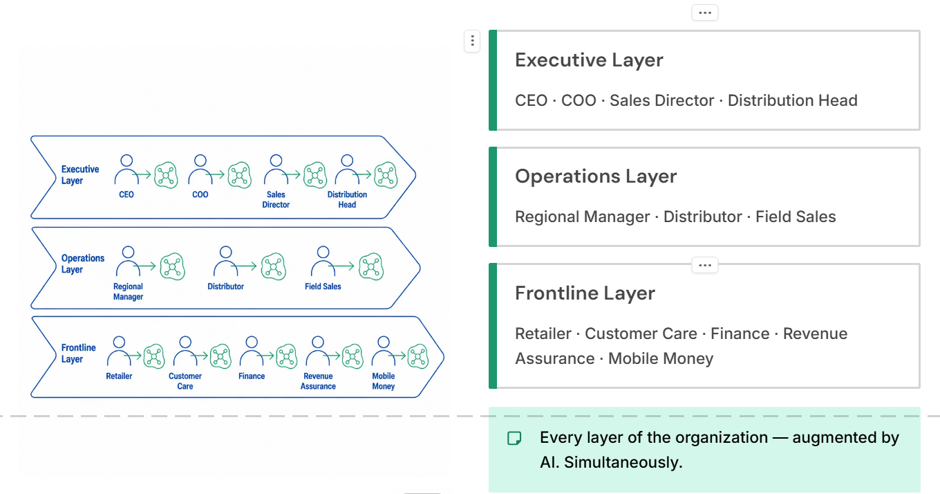
Telecom operators should think less of AI as software and more as a business capability that continuously learns, predicts, and recommends.
Q5. How are changing consumer expectations around seamless digital experiences influencing product innovation across telecom, payments, and financial services?
Consumers no longer compare experiences within an industry—they compare experiences across industries.
If a Quick Commerce food delivery app can complete a transaction in seconds, customers expect the same simplicity when applying for a loan, activating a mobile connection, or purchasing insurance.
This shift is forcing organizations to redesign products around customer journeys rather than organizational structures.
Products are becoming increasingly invisible. Authentication happens automatically (MCP, API keys). Payments happen in the background. Credit decisions are made in real time. Customers don’t necessarily want more features—they want fewer steps.
This has accelerated innovation in embedded finance, contextual payments, digital identity, AI-driven personalization, and conversational interfaces.
The companies that will succeed are those that eliminate friction before customers even notice it exists.
I often say that convenience has become the new competitive advantage. Technology is simply the mechanism that delivers it.
Q6. What impact do you expect regulatory developments around data privacy, digital identity, and cross-border payments to have on innovation and market expansion?
Many people think regulation slows innovation. I tend to see it differently.
Well-designed regulation creates trust, and trust is ultimately what allows digital ecosystems to scale. As data privacy frameworks mature,
• GDPR (General Data Protection Regulation)
• DPDP Act (Digital Personal Data Protection Act, 2023)
• CCPA/CPRA
Organizations will need to become more transparent about how they collect, govern, and use customer data. This will increase the importance of data governance, consent management, and explainable AI.
Digital identity will become a foundational layer for almost every digital interaction. Secure, interoperable identity systems will reduce fraud while making customer onboarding significantly more efficient.
Cross-border payments are another area poised for transformation. As interoperability improves and settlement speeds up, businesses of all sizes will find it easier to operate internationally, opening new markets previously constrained by complexity and cost. As seamless payment rails emerge, digital money and stablecoins will make cross-border payments instant. Companies like Terrapay are already comparing roaming with wallets with the international roaming networks.
The organizations that embrace compliance as a strategic capability—not merely a legal obligation—will be better positioned to expand across markets and build lasting customer trust.
Q7. If you were an investor looking at companies within the space, what critical question would you pose to their senior management?
I would ask a deceptively simple question:
“What is your moat? What unique capability will your business possess five years from now that your competitors cannot easily replicate?”
The answer reveals far more than financial projections.
If management talks only about technology, pricing, or market share, I take it with a pinch of salt - those advantages rarely endure.
What I would like to hear is how the company is building durable competitive advantages through proprietary data, ecosystem partnerships, AI capabilities, customer trust, distribution strength, execution excellence, or intellectual property.
Markets evolve rapidly. Products become commodities. I have seen prepaid systems/IN/OCS, SMSC, and top-up platforms, once considered innovation, become commodities. Technology can often be replicated.
Sustainable businesses are built on capabilities that compound over time.
Ultimately, I believe the strongest companies are not those that react fastest to change—they are the ones that consistently shape their industry's direction.
I would look for companies defining the Market, not just participating in it.
Need an expert in this space?
Talk to an Industry Expert
Knowledge Ridge connects decision-makers with carefully vetted subject matter experts for one-on-one calls, research sprints, and advisory engagements — across 11 sectors and 163 sub-industries globally.
Comments
No comments yet. Be the first to comment!