
Supply Chain Resilience in Chemicals
Q1. Could you start by giving us a brief overview of your professional background, particularly focusing on your expertise in the industry?
Regarding Fertilizers, I worked for one of the largest Nitrogen and phosphate fertilizer producers globally, SABIC, for 9 years until 2 years ago, putting my hands on project development regionally and globally, as well as business and global sales. Now I have shifted my focus to a wider industry scope (specialty chemicals), which covers business development and market studies on Paint and coating, Home and personal care, and cosmetics.
Q2. How are low-cost regional expansions in North America and the Middle East shifting the global nitrogen cost curve, and which high-cost assets are most vulnerable to being priced out?
Indian producers are enjoying steady gains from local demand and heavy subsidies that are not anticipated to be waived; however, we have seen moves by the government to push companies to find alternatives (nano Urea Fertilizers and others) to avoid draining the country's coffers. On the other hand, expansions in North America with cheaper/accessible raw materials are struggling to foresee the future. Shall I look heavily into green/blue products, or capitalize on the downstream? Both regions created a supply gap and room for low-cost producers globally to grow, including Russia, Iran, Saudi Arabia, and others. Eventually, low-cost producers gain further market share and credibility over others, and they can even certify blue products and, eventually, green ones.
Q3. What hidden maritime or tariff bottlenecks regularly disrupt fertilizer flows from North American ports into major South American agricultural markets like Brazil and Chile?
North American producers are between two swings: environmental and non-environmental. Brazil and Latin America generally aren't there yet and still follow the cheapest raw materials for their agricultural products. Continuing to choke the industry with environmental concerns at this stage will divert efforts from fighting hunger and producing more crops. Farmers are still not concerned about this, and market share will shift towards the regular scheme once all subsidies for environmentally friendly products are removed.
Q4. For local blending operations in the paint and specialty coatings space, how exposed are operating margins to sudden international supply chain volatility on critical additives?
The paint and coating industry generally has alternatives to its additives; this applies to well-developed countries with strong chemical expertise, such as India, China, Europe, and others. The challenge comes for specialty coatings and the Arab region, where they are not yet chemically mature (though they are giants in petrochemicals, and still they heavily rely on expats in the downstream). Specialty coatings are critically sensitive, as we have struggled to supply those additives; some companies even used air cargo to secure critical raw materials, yet they can survive because margins are sufficient. We are not talking about Architectural Paint here (as they are struggling big time even before any crises, as they are operating at record-low capacity).
Q5. During periods of agricultural commodity price compression, how resilient is the demand volume for specialty agri-nutrients given their higher price point than standard urea?
If we are talking about new specialty products, farmers won't take the risk. But if we are talking about well-known specialty products that have already become a new norm instead of Urea (such as coated Urea), so we see them still demanding, but at more cautious quantities (most global farmers are applying beyond what the soil need, however application rate to farmer is a perception).
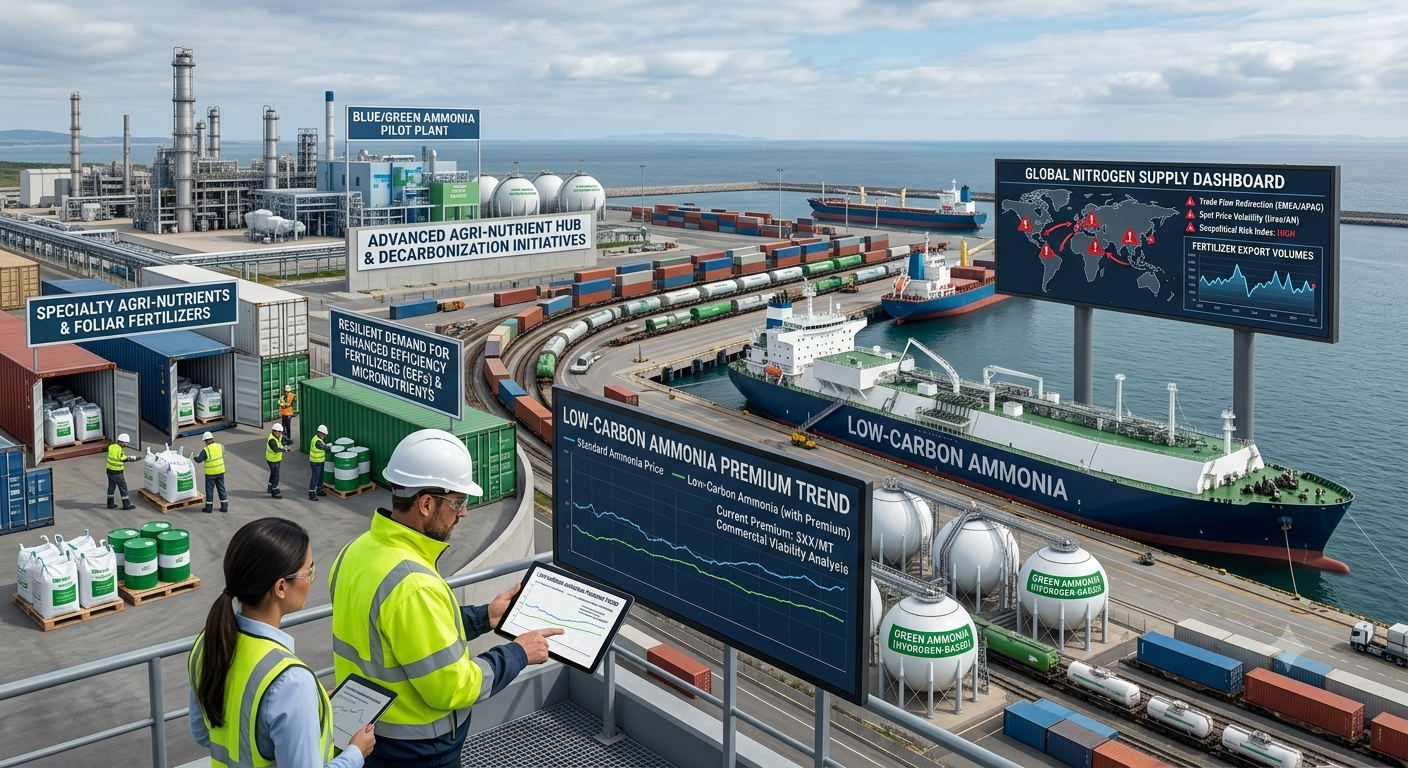
Q6. Given that the market frequently prices low-carbon ammonia at a massive premium based on future decarbonization mandates, what are the current commercial realities regarding premium price acceptance from traditional agricultural off-takers?
Let's be careful when we say "premium," 'cause we think buyers across the chain will absorb it, but that's not always the case. Some companies are willing to take the risk to distinguish themselves, and they will succeed. But let's accept the fact that both worlds (low-carbon and normal carbon-based ammonia) will exist; let's just be reasonable in our assumptions.
Q7. If you were an investor looking at companies within the space, what critical question would you pose to their senior management?
Sustainable sourcing is a key factor; cash flow for these industries is critical because they are commoditized, and whatever specialty there is, it will adapt to a new commodity norm.
Need an expert in this space?
Talk to an Industry Expert
Knowledge Ridge connects decision-makers with carefully vetted subject matter experts for one-on-one calls, research sprints, and advisory engagements — across 11 sectors and 163 sub-industries globally.
Comments
No comments yet. Be the first to comment!