Knowledge Ridge

The Future of India's Solar Ecosystem

The Future of India's Solar Ecosystem

July 14, 2026 6 min read Energy
#Solar Manufacturing, Renewable Energy, Solar
The Future of India's Solar Ecosystem

Q1. Could you briefly describe the roles where you were directly responsible for manufacturing scale-up, project execution, or operational outcomes, including the scale of facilities or teams managed?

In my previous roles, I was responsible for solar PV Cell and Module manufacturing plant setup, operations, production scale-up, and cross-functional project execution. My responsibilities included improving project coordination, project management, production efficiency, capacity expansion, process optimization, and quality management, as well as coordinating engineering, procurement, and operations teams. I managed projects and manufacturing teams, drove cost-reduction initiatives, and ensured projects were delivered on schedule while meeting quality and safety standards. For the last 20 years, I have worked at ADANI, TATAPOWER, LANCO, etc., and I started my consultancy in 2022 as YNY. We have done PMC work with many solar PV manufacturing companies.


Q2. How do you see the Indian solar manufacturing ecosystem evolving as the country pushes toward greater self-reliance and reduced import dependence?

India is moving from being primarily a module assembler to building an integrated manufacturing ecosystem. Government initiatives such as Production Linked Incentives (PLI), Basic Customs Duty (BCD), and Approved List of Models and Manufacturers (ALMM) are encouraging domestic investments. While dependence on imported wafers and polysilicon remains, significant investments in upstream manufacturing are expected over the next five to seven years. The long-term success will depend on technology competitiveness, manufacturing efficiency, and reliable supply chains. By adding this, the government has provided the PMSurya ghar subsidy and Solar pump subsidy for using DCR Solar Panels and Solar cells. This will ensure self-reliance on solar in India.


Q3. How are Indian manufacturers positioning themselves against aggressive capacity expansion from Chinese solar companies?

Indian manufacturers cannot realistically compete solely on cost with Chinese producers. Instead, they are focusing on:
•    Vertical integration to improve cost control.
•    Higher-efficiency technologies such as TOPCon and HJT.
•    Government-supported domestic demand.
•    Quality, bankability, and supply chain resilience.
•    Export opportunities driven by geopolitical diversification.
Operational excellence and continuous technology upgrades will remain critical differentiators.


Q4. How is the competitive landscape changing as integrated players expand across wafers, cells, modules, and energy storage solutions?

Competition is shifting from standalone module manufacturing to fully integrated energy solution providers. Companies that control multiple stages of the value chain can improve margins, reduce supply risk, and respond faster to market changes. Energy storage integration is becoming increasingly important because customers are seeking dispatch able renewable power rather than standalone solar generation. Future competition will increasingly revolve around integrated energy ecosystems rather than individual products.


Q5. How are sustainability and ESG expectations influencing manufacturing practices within the solar industry?

ESG considerations are becoming an important competitive factor. Manufacturers are investing in:
•    Renewable energy for captive manufacturing.
•    Water recycling and lower water consumption with ZLD process.
•    Waste reduction and material recovery.
•    Responsible sourcing and supply chain transparency.
•    Carbon footprint reporting and lifecycle assessments.
Global customers and institutional investors increasingly expect measurable ESG performance alongside competitive pricing.


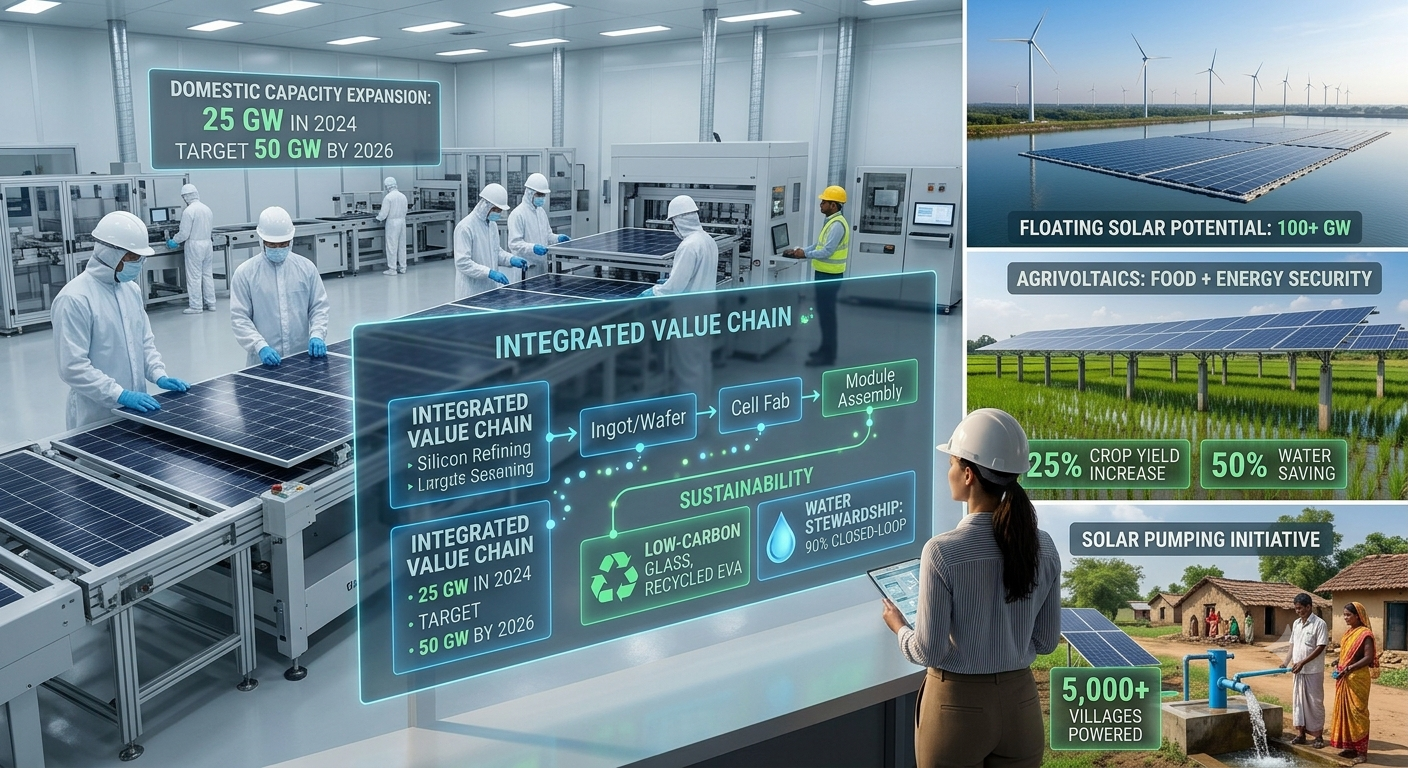
Q6. What market opportunities do you foresee in areas such as floating solar, agrivoltaics, solar water pumping, and hybrid renewable systems?

Each of these segments addresses different market needs:
•    Floating solar maximizes power generation where land availability is limited while reducing evaporation.
•    Agrivoltaics enables dual land use by combining farming and electricity generation, and NLC is working on more than 50MW of solar plant area with Agrivoltaics.
•    Solar water pumping has strong long-term demand in agriculture, particularly through government-supported rural electrification programs.
•   Hybrid renewable systems combining solar, wind, and battery storage (BESS) are likely to see the fastest growth because they provide higher reliability and better grid integration.
Among these, hybrid renewable systems with storage are likely to generate the greatest long-term investment opportunities.


Q7. If you were allocating capital into a solar or renewable energy business today, what question would you ask management that most investors overlook, and what answer would concern you?

If I were allocating capital into a renewable energy business, I would ask management:
"What is your sustainable competitive advantage if government incentives decline, import protection is reduced, and solar module prices continue to fall?"
Many investors focus on capacity expansion, revenue growth, and order books, but I believe the real test is whether the company can remain profitable during industry downturns.
I would look for strengths such as low-cost manufacturing, a clear technology roadmap, disciplined capital allocation, operational efficiency, and a diversified customer base.
The answer that would concern me most is if management relies mainly on government subsidies, tariffs, or continuous capacity expansion to justify future profitability. I would also worry if they lack a clear plan for adapting to rapidly changing solar technologies.
Ultimately, I prefer businesses that can generate sustainable returns through structural competitiveness rather than temporary policy support or favorable market conditions.


Need an expert in this space?

Talk to an Industry Expert

Knowledge Ridge connects decision-makers with carefully vetted subject matter experts for one-on-one calls, research sprints, and advisory engagements — across 11 sectors and 163 sub-industries globally.


Comments

No comments yet. Be the first to comment!

Newsletter

Stay on top of the latest Expert Network Industry Tips, Trends and Best Practices through Knowledge Ridge Blog.

Our Core Services

Explore our key offerings designed to help businesses connect with the right experts and achieve impactful outcomes.

Expert Calls

Get first-hand insights via phone consultations from our global expert network.

Read more →

B2B Expert Surveys

Understand customer preferences through custom questionnaires.

Read more →

Expert Term Engagements

Hire experts to guide you on critical projects or assignments.

Read more →

Executive/Board Placements

Let us find the ideal strategic hire for your leadership needs.

Read more →