
The Software-Driven Automotive Future
Q1. Could you start by giving us a brief overview of your professional background, particularly focusing on your expertise in the industry?
With nearly 30 years in the automotive industry, I’ve had the opportunity to immerse myself in many areas—including design and development, manufacturing, logistics, supplier quality, purchasing, project management, and strategic sourcing. My career has allowed me to work hands-on with both traditional and electric vehicle technologies, always emphasizing localization, cost efficiency, supplier partnerships, and the complexities of managing global supply chains.
Over the years, I’ve been involved in every stage of the product lifecycle—from designing and developing products to selecting suppliers, planning logistics, launching new products, scaling up manufacturing, ensuring quality, providing after-market support, and driving cost competitiveness. More recently, I’ve focused on sourcing key EV components like electric drive motors, power electronics, semiconductors, rare earth permanent magnets, electronic parts, and precision mechanical assemblies.
Much of my career has centered on building strong, flexible global supply chains and optimizing logistics networks—even in the face of challenges like semiconductor shortages, geopolitical shifts, and growing localization demands. I’ve worked closely with engineering, manufacturing, logistics, and procurement teams, as well as suppliers throughout Europe and Asia, focusing on value engineering, should-cost analysis, lean manufacturing, and strategies to manage risk.
The automotive industry is experiencing its biggest transformation in decades, fueled by electrification, software-defined vehicles, connectivity, and a drive toward sustainability. Thanks to my broad background in design, engineering, logistics, manufacturing, quality, and strategic sourcing, I’m able to look at these changes not just through a technology lens, but also from the perspectives of product development, procurement strategy, manufacturing readiness, supply chain strength, and commercial viability.
Q2. How do you see the automotive industry evolving as electrification, connectivity, software, and autonomous technologies converge into a single mobility ecosystem?
The automotive industry is shifting from a focus on hardware to a fully integrated mobility ecosystem, where software plays an ever-growing role in shaping what vehicles can offer. Electrification, connectivity, software-driven design, and autonomous technology are no longer separate trends—they’re now tightly linked and shaping the future together.
Electric vehicles lay the groundwork for software-driven features, thanks to their centralized electrical systems and greater computing power. Connectivity makes it possible to deliver ongoing software updates, run predictive diagnostics, optimize fleets, and create more personalized experiences for drivers and passengers. At the same time, autonomous technologies are raising the bar for high-performance computing, advanced sensors, AI, and real-time data processing.
This coming together of technologies is set to transform how vehicles are developed. In the future, what sets vehicles apart won’t just be mechanical engineering, but also their software, cybersecurity, AI, cloud integration, and the overall user experience.
The supply chain is changing too. Established Tier-1 suppliers are moving into software and electronics, while semiconductor companies and tech firms are playing bigger roles as key automotive partners. Working together across hardware, software, cloud services, and digital platforms will be more important than ever.
People will soon expect their vehicles to keep getting better over time, thanks to over-the-air updates—instead of staying the same as the day they were bought. This change opens the door for new, ongoing revenue streams through subscription services and digital add-ons.
In the end, the automakers who bring together advanced electrical systems, strong software platforms, cutting-edge semiconductors, and agile ways of working will be the ones who lead the future of mobility.
Q3. How is the EV value chain evolving beyond batteries, and which component categories stand to benefit the most from the next phase of electrification?
Although batteries still make up the biggest share of EV costs, the industry’s next chapter is about much more than just battery technology. As more people choose electric vehicles, there’s a growing focus on making the whole system more efficient, cutting down on weight, boosting power density, and building supply chains that can handle new challenges.
Electric drive units are now being designed as highly integrated packages—bringing together motors, gearboxes, and inverters into compact e-axle solutions. Meanwhile, power electronics are quickly becoming a hot segment because of the push for higher efficiency and faster charging.
Rare earth permanent magnets—especially high-performance NdFeB magnets—are still key for traction motors, even as new motor technologies are explored. Thermal management systems are getting more advanced, helping to keep batteries, power electronics, and cabins comfortable with integrated heat pump designs.
On top of that, components like high-voltage connectors, busbars, embedded software, advanced sensors, onboard chargers, DC-DC converters, battery management systems, and charging infrastructure are all seeing strong growth.
At the same time, lightweight materials like aluminum die castings and advanced composites are becoming more important, as automakers look for ways to get the most out of every mile of driving range.
But it’s not just about technology—finding and sourcing critical materials, semiconductors, magnets, and electronic assemblies closer to where vehicles are made will matter just as much. Companies that can build strong, diverse supply chains across regions, while keeping costs competitive, will be well positioned for long-term success.
Q4. How do you see technologies such as SiC and GaN influencing the next generation of EV performance, efficiency, and cost structures?
Wide-bandgap semiconductors are bringing some of the biggest changes we’ve seen in EV power electronics.
Take silicon carbide (SiC), for example—it’s already making a big impact on traction inverters by allowing for higher switching speeds, less energy loss, better heat management, and more driving range. While SiC devices do cost more upfront, those costs are often offset by savings from smaller cooling systems, lighter components, and better overall efficiency.
Gallium nitride (GaN) is starting to make its mark, especially in onboard chargers, DC-DC converters, and other auxiliary power uses. Because GaN can run at very high frequencies, it allows for smaller magnetic parts, quicker charging times, and greater power density.
Looking ahead, SiC is expected to catch on quickly in premium and high-performance EVs, and then gradually filter down to mid-range models as production scales help bring costs down. Meanwhile, GaN is likely to see strong growth in lower- and medium-power applications—places where efficiency and compact design really matter.
On the supply chain side, the growing need for SiC wafers, epitaxy, new packaging technologies, and specialized manufacturing equipment is shaking up the entire supplier landscape. Companies that build strong partnerships for semiconductor supply and invest in advanced packaging will have a real edge over the competition.
In the end, both SiC and GaN are set to deliver better efficiency, faster charging, improved thermal management, and lower overall system costs—making them essential for the next wave of electric mobility.
Q5. How is the transition toward software-defined vehicles changing product development priorities across the automotive ecosystem?
Software-defined vehicles fundamentally change how vehicles are engineered, manufactured, and monetized.
Historically, automotive development focused on optimizing individual electronic control units. Today, manufacturers are moving toward centralized computing architectures with significantly fewer but more powerful processors managing multiple vehicle domains.
This shift requires software development to begin much earlier in product programs and continue long after vehicle production through continuous software updates. Cybersecurity, functional safety, cloud connectivity, AI integration, and software validation are becoming core engineering competencies.
Product development is increasingly adopting agile methodologies, continuous integration, digital twins, and virtual validation to shorten development cycles while improving software quality.
The supplier ecosystem is also evolving. Component suppliers are expected to deliver not only hardware but also embedded software, cybersecurity support, and lifecycle software maintenance. Collaboration between automotive manufacturers, semiconductor companies, cloud providers, and software firms is becoming increasingly important.
Business models are changing as well. Software-enabled features, subscription services, predictive maintenance, and digital upgrades are creating recurring revenue opportunities beyond the initial vehicle sale.
Success in the SDV era will depend on an organization’s ability to integrate hardware, software, electronics, cloud services, and AI into a unified development ecosystem while maintaining safety, reliability, and regulatory compliance.
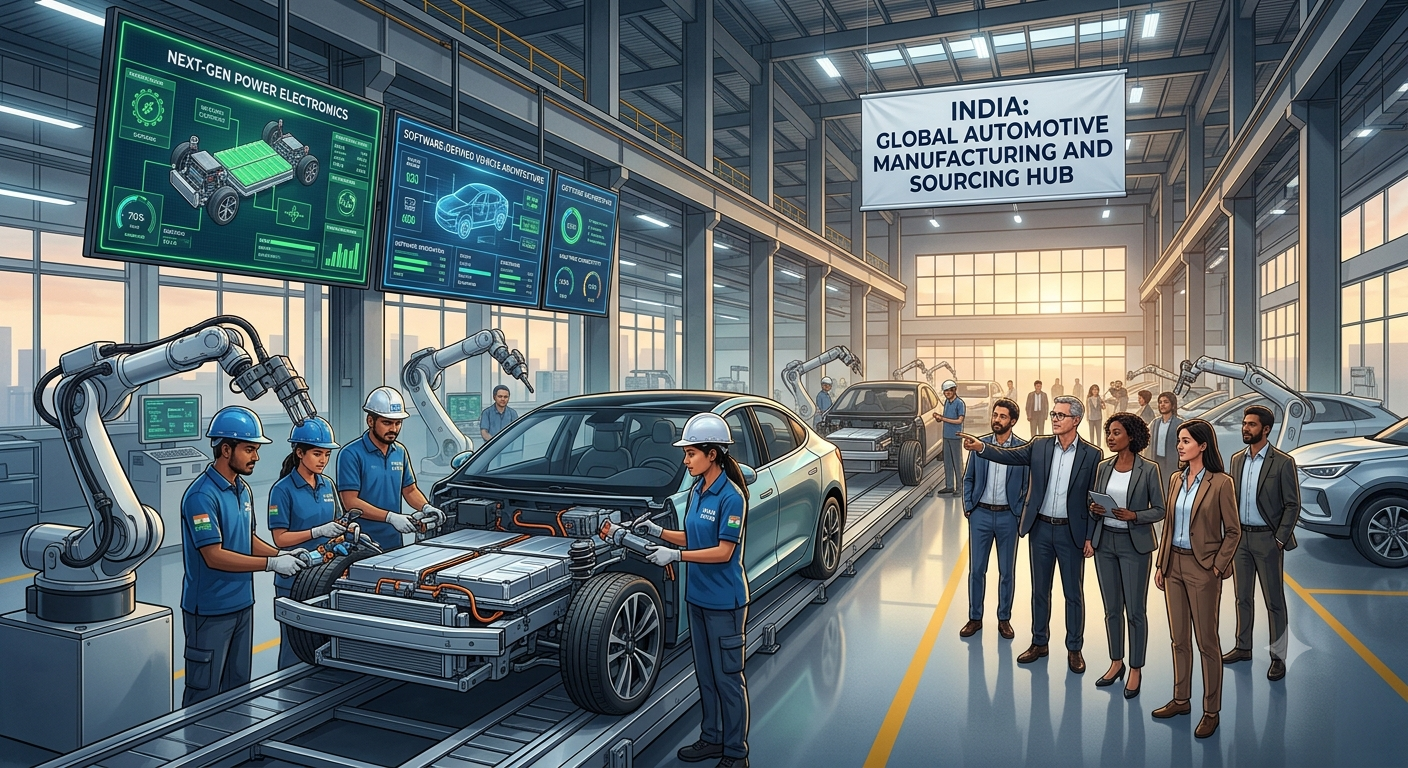
Q6. What opportunities are emerging for India as global automotive companies seek alternative manufacturing and sourcing destinations?
India is well positioned to become one of the world’s most important automotive manufacturing and engineering hubs.
Several factors support this opportunity, including a large engineering talent pool, competitive manufacturing costs, expanding domestic demand, supportive government policies, and rapidly improving supplier capabilities. Programs promoting semiconductor manufacturing, advanced chemistry cells, electronics manufacturing, and electric mobility are strengthening the country’s industrial ecosystem.
Beyond vehicle assembly, India has significant opportunities in precision engineering, power electronics, embedded software, automotive electronics, lightweight components, electric motors, charging systems, and engineering services.
Global companies are increasingly diversifying supply chains beyond China to improve resilience. India can benefit by offering reliable manufacturing, engineering expertise, and strong process quality across multiple automotive domains.
To fully capitalize on this opportunity, India must continue strengthening semiconductor capabilities, rare earth processing, advanced materials, industrial automation, logistics infrastructure, and supplier quality systems. Investment in research, workforce development, and intellectual property creation will also be essential.
The greatest opportunity lies not simply in becoming a low-cost manufacturing destination but in becoming a strategic innovation and engineering partner for global automotive companies developing next-generation mobility technologies.
Need an expert in this space?
Talk to an Industry Expert
Knowledge Ridge connects decision-makers with carefully vetted subject matter experts for one-on-one calls, research sprints, and advisory engagements — across 11 sectors and 163 sub-industries globally.
Comments
No comments yet. Be the first to comment!