
Evolving Export Finance Landscape
Q1. Could you start by giving us a brief overview of your professional background, particularly focusing on your expertise in the industry?
I am an economist and have worked largely in promoting India’s international trade and investment. I have worked in leading India’s Think Tanks, India’s trade promotion organization, a leading chamber of commerce in India, and an apex export financing institution.
My experience also includes providing export services, training and development, and hand-holding of Indian exporters.
Q2. Which structural shifts in global trade are likely to have the greatest impact on India's export financing landscape over the next five years?
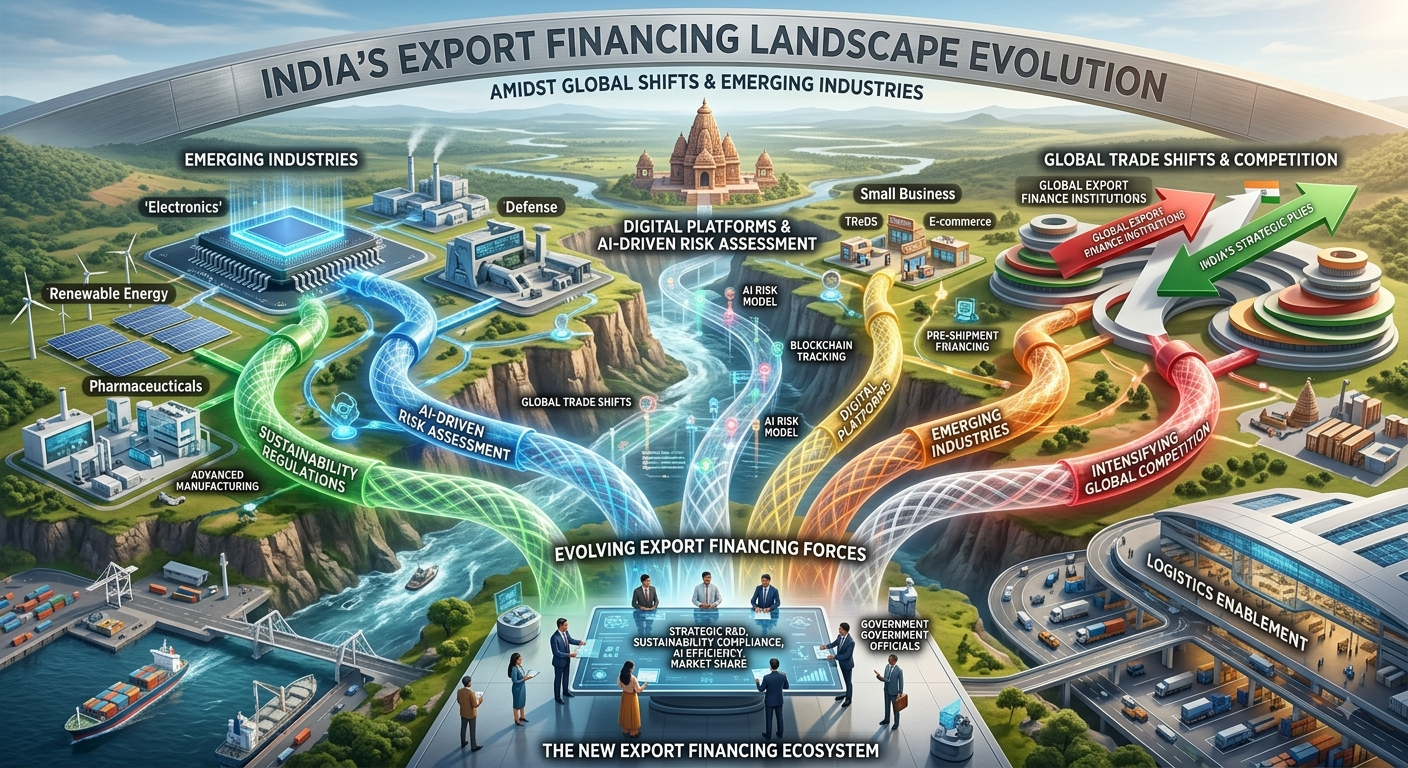
Global trade is increasingly moving towards developing nations. The share of developing nations in global trade was about 30% in 2000 and has now increased to nearly 50%. There is also a shift in trade trends, with increasing flows among developing nations. Countries earlier considered as raw materials and intermediate goods exporters are now entering manufacturing and exports. These trends change the landscape of export financing.
Many importers, especially from developing countries, are looking for finance as a major requirement when deciding on sourcing their import requirements. Though quality and cost of products are other key metrics in their sourcing requirements, finance is the driving metric.
With a shift in supply chains, especially due to larger participation by developing nations, there are growing requirements for export-related infrastructure (like ports, roads, rail networks, etc.) in these countries. Such a surge in demand offers Indian project exporters the opportunity to bid and execute projects in other developing countries. Again, offering finance for such projects becomes a bid-winning strategy.
Q3. Which emerging industries do you believe are becoming strategically important for export financing, and what is driving that shift?
To identify the sectors, one should identify which sectors are strategically important for India. The Government has already identified more than two dozen sectors that are considered strategically important for India to reduce the country’s import dependence. These sectors also offer export opportunities eventually, once export surplus is generated. For ease, one could classify the sectors into the following broad categories.
1. Financing for Creation of Export Capability – as regards sectors, electronics, specialty chemicals, renewable energy-related products (solar cells/panels), industrial plastics, high-end precision equipment, scientific instruments, etc
2. Merchandise Export Financing – sectors such as textiles, processed agro-products, pharmaceuticals, gems and jewelry, plastics, automobiles/products, light engineering goods, etc.
3. Project Exports Financing – heavy machinery, equipment, capital goods, construction services, engineering services, turnkey implementation services, etc. that require medium/long-term export financing.
Q4. How are sustainability-linked trade policies, carbon regulations, and ESG expectations influencing export competitiveness and access to finance?
Developed countries are imposing sustainability-linked trade policies and carbon regulations on developing countries, which influence global trade patterns. An important example to cite is the carbon tax (Carbon Border Adjustment Mechanism). Sectors such as Iron and Steel, Aluminum, Cement, and fertilizers are affected by such regulations. The landing price of such products increases significantly, reducing competitiveness.
Many OECD countries also impose labor conditions while sourcing products from developing nations, which either increases the cost of compliance or reduces their competitiveness. The recent US tariff levy on India and other countries for ‘forced labor’ is another example.
Overall, these measures influence export competitiveness, but not much in their access to finance.
Q5. What role do digital trade platforms, AI, and data-driven risk assessment play in transforming the future of export finance?
A report by the US International Trade Administration estimates that the B2B E-Commerce market is likely to be valued at USD 36 trillion in 2026. The Asia-Pacific region, and especially India, will gain market share, and the leading segments are consumer electronics, fashion, toys, health products, food and beverages, and bio-pharma. Most e-commerce players are likely to be MSMEs, and they will surely require credit facilities. The Government of India’s Export Promotion Mission addresses these requirements by introducing alternative financing instruments. Credit assistance is provided to e-commerce exporters with interest subvention and credit guarantee cover of up to Rs 50 lakhs with 90% coverage. Support will also be provided to encourage them to adopt export factoring solutions.
Recently, the Government of India has eased the rules for FDI in e-commerce, facilitating larger investments by multinational e-commerce companies. Now, companies like Amazon can purchase products directly from sellers and export them through digital platforms. With such easing of restrictions, inventory ownership limits are removed, which opens up opportunities for financing.
AI and data-driven risk assessment are emerging as a revolutionary force in financial risk management, especially in fraud detection and predictive analytics. However, issues related to data quality and ethical considerations prevent widespread adoption. The use of Blockchain in Trade Finance has already gained significant traction. However, there exists a regulatory gap in the widespread adoption of such technologies in international trade transactions.
Q6. How do you see the competitive landscape evolving among export credit agencies and development finance institutions globally?
All over the world, Export Credit Agencies (ECAs) are established by national governments, and thus their operations are guided by the national interest. Thus, the export credit agencies and/or Development Finance Institutions (DFIs) have competing interests.
Nevertheless, there are multiple areas and scope for cooperation among ECAs and DFIs. ECAs across the world are enhancing their focus on project exports on the one hand, and MSMEs on the other. In the context of project exports, the large size of financing requirements often makes it difficult for a single lender to finance the entire project on its own. Globalization has also made projects increasingly dependent on multi-country sourcing of goods and services. Collaboration among ECAs and national DFIs can substantially enhance trade financing capabilities while concomitantly meeting growing infrastructure requirements.
Another way in which ECAs and DFIs can collaborate is through information sharing and creation of an enabling environment for financing. All institutions face challenges in financing projects that may originate from regulatory issues, structural challenges, public sector inefficiencies, etc. Structured exchange of information can reap substantial benefits for these institutions. These institutions can also collaborate in the sphere of creation of bankable projects through initiatives such as project preparation facilities.
Need an expert in this space?
Talk to an Industry Expert
Knowledge Ridge connects decision-makers with carefully vetted subject matter experts for one-on-one calls, research sprints, and advisory engagements — across 11 sectors and 163 sub-industries globally.
Comments
No comments yet. Be the first to comment!