Reimagining Digital Lending
Q1. Could you start by giving us a brief overview of your professional background, particularly focusing on your expertise in the industry?
I design and build financial services platforms, from the architecture right down to the production code, which I still write every day even now.
Over the last 27 years, I have sat on all three sides of this problem. As a CTO, I have built platforms from scratch. At Bajaj MARKETS, I conceptualized and built one of India's first multi-product financial marketplaces, with more than 28 products across lending, cards, insurance and investments, onboarding banks, NBFCs and insurers through standardized APIs.
At Rahi Platform Technologies, I have spent the last two years building a cloud-agnostic SaaS lending platform covering origination, loan management and collections. It runs on an entirely open-source stack, with no licensed software and no cloud lock-in.
As a Partner at BCG, I advised banks and NBFCs on their technology strategy, on build-versus-buy decisions, and on legacy modernization. Before that, as Chief Architect at Cognizant, I ran the banking and financial services architecture practice across APAC, the UK, and Europe.
So, I have built lending stacks, advised others on them, and modernized the legacy systems they are meant to replace. That practitioner's lens, of someone who feels the friction of real implementation rather than simply drawing boxes on a whiteboard, is what I bring to this space.
Q2. What structural shifts do you think will define the next phase of the digital lending market over the next five years?
I see four shifts coming, and none of them are about slicker apps.
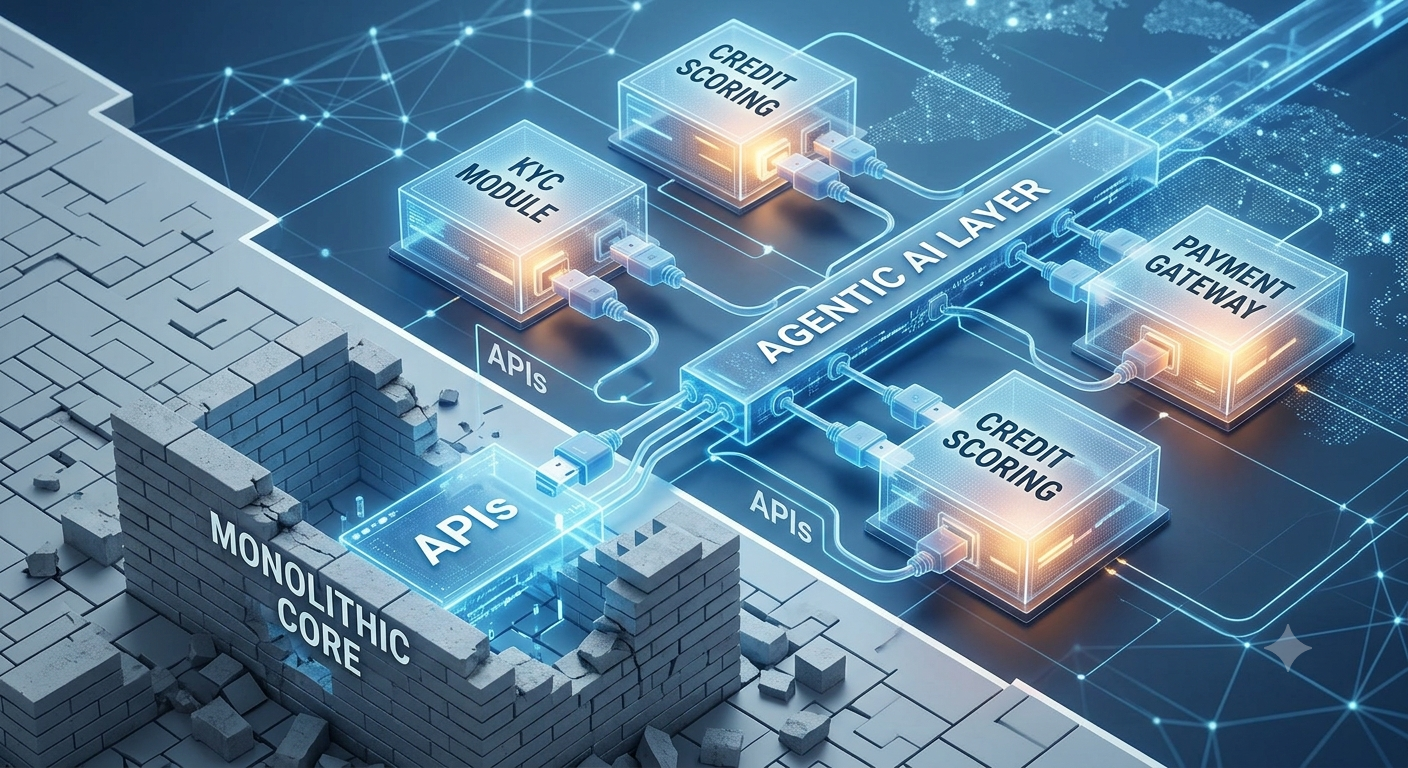
The first is the unbundling of the lending stack. The monolithic loan management system is being pulled apart into composable services, such as origination, decisioning, disbursal, servicing and collections, which can then be assembled per product. The winners here will be the infrastructure players, not the front-ends.
The second is that the regulator becomes an architectural input, not an afterthought. In India, the Digital Lending Guidelines, the account aggregator rails and the co-lending framework mean that compliance, data flow and clarity on the lender-of-record now have to be designed into the platform itself. Regulation is actively shaping the topology of these systems.
The third is the move from balance-sheet lending to distributed, co-lended and embedded credit. Credit is increasingly originated at the point of need, inside someone else's product, with the risk split across multiple balance sheets. This demands platforms that can reconcile, split and settle across parties in real time.
The fourth is data density. Account aggregator data, GST data, UPI transaction history and other alternative signals mean underwriting is moving from thin-file guesswork to rich, event-driven risk assessment. The platform that can ingest and act on that stream cheaply will pull ahead.
The common thread across all four is simple. Value is migrating away from whoever owns the customer, and towards whoever owns the rails.
Q3. How are customer expectations reshaping the evolution of lending platforms beyond faster loan processing?
Speed was the last decade's battle, and it is largely won. A loan in minutes is table stakes now. The next set of expectations is much harder to build for.
The first is contextual credit. Customers no longer want to “apply for a loan”; they want credit to appear at the very moment they need it, inside the app they are already using. This pushes lending into embedded, almost invisible flows, and it forces the platform to be API-first, because the point of origination is no longer your own screen.
The second is continuity and memory. Customers expect the lender to already know them, with pre-approved lines, one-tap top-ups, and no re-submitting the same documents again and again. That is an architectural demand for a persistent customer and risk graph, not a series of stateless applications.
The third is transparency and control. People want clear terms, and the ability to prepay, restructure, or renegotiate without having to call a call center. After the backlash around opaque fees and aggressive recovery, trust has become a genuine product feature.
The fourth is empathetic servicing, especially in collections. A struggling borrower should be treated as a relationship to preserve, not simply an account to chase.
Meeting all of this means the intelligence has to move out of the origination funnel and into servicing and the whole lifecycle, which is exactly where most platforms are still the weakest.
Q4. How do you see the market evolving between vertically integrated lending platforms and composable, API-first ecosystems?
I have built both, so I will be blunt. This is not a war that one side wins. It is a pendulum, and where you sit on it depends on your stage and your margins.
Vertical integration wins on control, on latency, on having a single source of truth, and on a clean regulatory audit trail. That is why regulated lenders-of-record often end up there. Composable, API-first architectures win on speed-to-market, on best-of-breed components, and on the ability to launch a new product without a full re-platforming exercise.
For most serious players, the real answer is a spine-and-limbs model. You own the core ledger, the risk decisioning, and the system of record, which are the things where correctness and control are existential. You then compose everything around them through APIs, such as KYC, bureau pulls, fraud checks, e-sign, and collections tooling.
The mistake I keep seeing is composing the core itself. When you outsource your ledger and your decisioning to five different vendors, you have distributed your source of truth and your accountability, and reconciliation becomes what eventually breaks you at scale.
So my rule is straightforward. Be composable at the edges, and integrated at the core.
Over the next five years, I expect the “core” that must be owned to keep shrinking as infrastructure providers earn trust. But decisioning and the ledger will be the last things to leave the house.
Q5. How do you expect agentic AI to transform loan origination, servicing, and collections over the next few years?
I am optimistic about this but let me separate the hype from what will actually work in production.
In origination, agentic AI moves us from form-filling to conversation and orchestration. An agent can gather documents, pull account aggregator and bureau data, resolve discrepancies, and assemble a decision-ready file, with a human approving the edge cases. The near-term value is collapsing the operational cost of underwriting a thin-file customer, not replacing the credit policy itself.
In servicing, this is where agents will land first and most safely. Think of round-the-clock handling of balance queries, top-up eligibility, restructuring simulations and foreclosure quotes. These are the high-volume, low-risk interactions that clog up call centers today.
In collections, agentic AI is genuinely transformative, but it is also the highest-risk zone. Done well, it means personalized, patient, multi-channel nudges, repayment plans negotiated in natural language, and empathy delivered at scale for early-stage delinquency. Done badly, it becomes automated harassment, and the regulator will put a stop to that very quickly.
So my honest framing is this. The agents will run the workflow, but the credit decision, the recovery conduct, and anything with legal or reputational decisions must stay under human governance.
The architectural prerequisite that everyone underestimates, and something I write about often, is that agents need clean semantics, proper data contracts, and a trustworthy system of record underneath them. If you point an agent at a messy loan ledger, you have simply automated your errors.
Q6. How do you expect the competitive landscape to evolve as fintech infrastructure providers increasingly compete with traditional core banking and lending platforms?
The incumbents, meaning the legacy core lending and banking platforms, win on trust, on their regulatory track record, and on the fact that they already run the money. Their weakness is architecture. They tend to be monolithic, license-heavy, expensive to change, and built for a batch-processing world.
The newer infrastructure providers win on developer experience, on API-first design, on cloud-native economics, and on speed. You can integrate with them in weeks rather than quarters.
Over the next five years, I expect a squeeze on the incumbents from below. The infrastructure players will keep peeling off the modern, greenfield and digital-native lenders, while the incumbents defend the large regulated institutions where switching costs and risk aversion are highest.
But two things will decide how far the newcomers actually get. The first is economics at scale. A lot of fintech infrastructure is priced per transaction or per API call, which looks cheap at pilot volume and becomes punishing at a million loans a month. The reason I built Rahi on open source, with no licensing and a non-linear marginal cost, is precisely to avoid that trap.
The second is regulatory endurance. Infrastructure providers have to prove that they can survive an audit, an outage, and a regulator's questions, not just a good demo.
My expectation is convergence. The incumbents will be forced to expose APIs and modernize or lose relevance, and the infrastructure providers will have to grow up on compliance and resilience. The real danger zone is the middle, which is the clunky, expensive, un-modernized legacy platform with no API story at all. That is where the failures will happen.
Q7. If you were an investor looking at companies within the space, what critical question would you pose to their senior management?
I would ask them this. “What is your marginal cost to originate and service one additional loan, and what happens to that number as you grow ten-fold?”
It sounds like a finance question, but it is actually an architecture question in disguise, and it flushes out everything.
If the answer is vague, or if the cost is roughly linear with volume, then they have built on a stack of per-transaction licenses and vendor API calls that will eat their unit economics alive the moment they scale. And that is the very moment the whole investment thesis depends on.
If they can answer it crisply, and the curve bends the right way, then it tells me they have made deliberate build-versus-buy decisions, they own the parts of the stack that matter, and someone technical is genuinely thinking about the business model, not just the feature roadmap.
I would then follow it up with a second question. “Where is your source of truth, and how many systems do you have to reconcile to arrive at it?”
Between those two answers, you learn whether you are looking at a real platform, or simply a demo with good margins today and no floor under it tomorrow.
Need an expert in this space?
Talk to an Industry Expert
Knowledge Ridge connects decision-makers with carefully vetted subject matter experts for one-on-one calls, research sprints, and advisory engagements — across 11 sectors and 163 sub-industries globally.
Comments
No comments yet. Be the first to comment!