Knowledge Ridge

The Future of Pharmaceutical Production

The Future of Pharmaceutical Production

July 28, 2026 8 min read Healthcare
#OSD, OSD Manufacturing, Pharma production
The Future of Pharmaceutical Production

Q1. How do you see oral solid dosage manufacturing evolving over the next decade as technologies, regulations, and patient expectations continue to change?

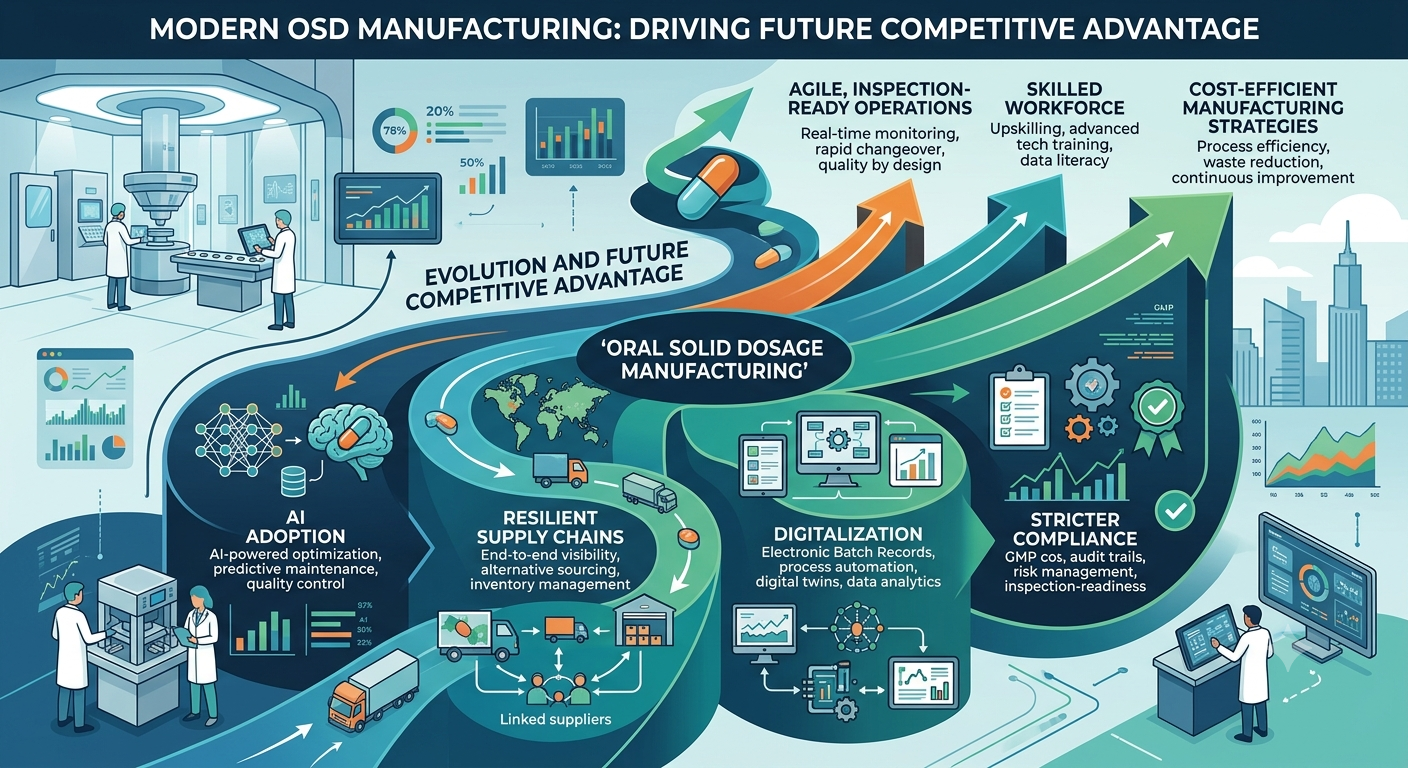
Technology Enhancement: Oral solid dosage (OSD) manufacturing will shift from being volume-driven to being intelligence-driven. Continuous manufacturing, advanced process analytical technology (PAT), digital twins, and AI-enabled process optimization will gradually complement conventional batch manufacturing, particularly for high-volume products. Manufacturing execution systems (MES), electronic batch records (EBR), and real-time release testing (RTRT) will become increasingly common as regulators encourage science- and risk-based manufacturing.
All improvements will be technology-centric to use less manpower. Many manual processes could be eliminated through technologies such as CPV monitoring, APQR preparation, and revised document review.

Patient expectations are also changing. Smaller batch sizes, faster product launches, personalized therapies, and improved adherence through modified-release formulations and combination products will require more flexible manufacturing platforms. Sustainability will become another competitive differentiator, with increased focus on solvent reduction, energy efficiency, water conservation, and carbon footprint reduction. Overall, future OSD facilities will emphasize flexibility, digital integration, quality-by-design (QbD), and data-driven operations rather than simply maximizing production capacity.


Q2. How do you see AI influencing manufacturing decision-making beyond traditional automation and process control applications?

AI’s greatest impact will be in augmenting human decision-making rather than replacing operators. Beyond process automation, AI will enable predictive quality by identifying subtle correlations between process parameters, raw material variability, environmental conditions, and product quality before deviations occur. Similarly, the doers-checker concept will be completely changed. I see that in the coming days, jobs in Quality will be impacted significantly.

AI will also support:

•    Cognitive Scheduling and De-bottlenecking: AI-driven Manufacturing Execution Systems (MES) ingest data from the ERP, Predictive maintenance and logs, and real-time operations to dynamically reschedule production when disruptions happen—optimizing labor, raw materials, and cleaning changeovers seamlessly.  
•    Predictive Deviation Management: Instead of just logging an Out of Specification (OOS) event after it happens, Machine Learning models look at historical process variables and soft sensors to predict batch failures hours before they occur, allowing operators to make in-flight parameter corrections. All critical process parameters(CPP) will directly predict the impact on Critical Quality Attributes (CQA)
•    Automated Root Cause Analysis: When quality deviations happen, LLMs and graph neural networks can ingest historical batch records, deviation logs, and technical documentation to pinpoint root causes in seconds, transforming CAPA (Corrective and Preventive Action) processes from slow, defensive procedures into rapid, predictive ones.  

Rather than relying solely on historical dashboards, plant leadership will increasingly use AI-generated recommendations to prioritize operational, quality, and financial decisions. Human expertise will remain essential for governance and final decision-making.


Q3. How are pharmaceutical manufacturers adapting their production strategies in response to increasing supply chain uncertainty and geopolitical risks?

Manufacturers are moving away from single-source, lowest-cost procurement models toward resilience-focused supply chains. 
Key strategies include:
•    Multiple sourcing of APIs and critical excipients
•    Geographic diversification of suppliers to reduce country-specific risks
•    Strategic safety stocks for high-risk materials
•    Greater vertical integration for critical intermediates and APIs
•    Regional manufacturing hubs closer to major markets
•    Enhanced supplier qualification and continuous risk monitoring
•    Increased digital visibility across the end-to-end supply chain

Organizations are also redesigning manufacturing networks to improve flexibility, allowing production to shift between qualified sites when disruptions occur. Although these strategies may increase short-term operating costs, they significantly improve business continuity and reduce the risk of product shortages.


Q4. As compliance standards become increasingly standardized globally, where do you see the next source of sustainable manufacturing advantage emerging?

As regulatory expectations converge globally, compliance alone will no longer provide meaningful competitive differentiation. Sustainable advantage will increasingly come from operational excellence and execution capability.

Future differentiators will include:
•    Faster technology transfer and product commercialization
•    Higher first-pass yield and right-first-time manufacturing
•    AI-driven continuous process improvement
•    Superior data integrity and digital maturity
•    Agile manufacturing capable of responding quickly to market demand
•    Lower conversion costs through automation and optimized resource utilization
•    Strong talent development and knowledge management
•    Sustainability through efficient energy, water, and waste management
For sustainability and to remain competitive, organizations that consistently manufacture high-quality products at lower cost, with greater agility and higher reachability, will outperform competitors even when all operate under similar regulatory standards.


Q5. How do you see the intersection of inspection readiness, digitalization, workforce transformation, and cost optimization shaping the future pharmaceutical plant?

In the future, we will see more dark factories in pharmaceuticals, conceptualized like automobile or semiconductor factories. Since all batch data will be in real time and all CPP and CQA will be easily correlated, this will increase the confidence level of inspections. I also see its long-term benefit in reducing regulatory inspections or high-impact site inspections; digitalization will provide real-time visibility into manufacturing, quality, maintenance, and compliance activities. Electronic batch records, integrated quality systems, and automated data capture will enable continuous inspection readiness rather than preparation immediately before audits.

The workforce transformation will evolve toward higher-value analytical and problem-solving roles as repetitive documentation and administrative tasks become automated. Employees will require stronger digital literacy, data interpretation, and cross-functional collaboration skills.
Cost optimization will increasingly result from fewer deviations, reduced batch failures, shorter release cycles, predictive maintenance, improved asset utilization, and streamlined compliance processes rather than simple workforce reductions.
The pharmaceutical plant of the future will therefore be connected, data-driven, inspection-ready by design, and supported by a digitally skilled workforce capable of continuously improving operational performance.


Q6. If you were approving capital expenditure for a new manufacturing facility today, what capability would receive funding first, and which traditional investment would you question most aggressively?

The highest-priority investment would be an integrated digital manufacturing architecture from the outset, including MES, electronic batch records, integrated quality management systems, data historians, advanced analytics, cybersecurity, and infrastructure that supports AI applications. Building digital capabilities during facility design is significantly more efficient than retrofitting them later.
I would also prioritize flexible manufacturing equipment that can accommodate multiple products, rapid changeovers, and future process improvements without major capital reinvestment.

The traditional investment I would scrutinize most closely is excess dedicated manufacturing capacity built solely for forecasted peak demand. Given increasing market volatility, shorter product lifecycles, and more flexible manufacturing technologies, oversized facilities often lead to poor asset utilization and higher fixed costs.


Need an expert in this space?

Talk to an Industry Expert

Knowledge Ridge connects decision-makers with carefully vetted subject matter experts for one-on-one calls, research sprints, and advisory engagements — across 11 sectors and 163 sub-industries globally.


Comments

No comments yet. Be the first to comment!

Newsletter

Stay on top of the latest Expert Network Industry Tips, Trends and Best Practices through Knowledge Ridge Blog.

Our Core Services

Explore our key offerings designed to help businesses connect with the right experts and achieve impactful outcomes.

Expert Calls

Get first-hand insights via phone consultations from our global expert network.

Read more →

B2B Expert Surveys

Understand customer preferences through custom questionnaires.

Read more →

Expert Term Engagements

Hire experts to guide you on critical projects or assignments.

Read more →

Executive/Board Placements

Let us find the ideal strategic hire for your leadership needs.

Read more →