
The Next Era of Healthcare Innovation
Q1. Could you start by giving us a brief overview of your professional background, particularly focusing on your expertise in the industry?
I'm a technology and product leader with a strong background in healthcare technology, AI/ML, digital transformation, and enterprise product innovation. At Optum (UnitedHealth Group), I've spent years building data-driven healthcare solutions designed to improve patient outcomes and make operations run more smoothly.
My experience blends product management, business strategy, and cutting-edge technologies like generative AI, machine learning, cloud platforms, healthcare analytics, and digital health. Throughout my career, I've been able to turn complex business challenges into practical, innovative technology solutions, all while leading cross-functional teams and shaping product strategy.
Innovation has been a consistent thread in my work. I've earned several U.S. patents related to machine learning and healthcare tech and was honored as a UHG Senior Inventor. I also enjoy sharing what I learn—whether it's through articles, industry discussions, or thought leadership on AI, healthcare transformation, and product innovation. My commitment to learning is ongoing, as reflected in my LinkedIn profile, where I've earned certifications in Scrum Product Ownership, Generative AI, and cloud technologies.
Q2. How is the adoption of GenAI and Agentic AI changing the way healthcare organizations manage clinical data, risk, and quality programs?
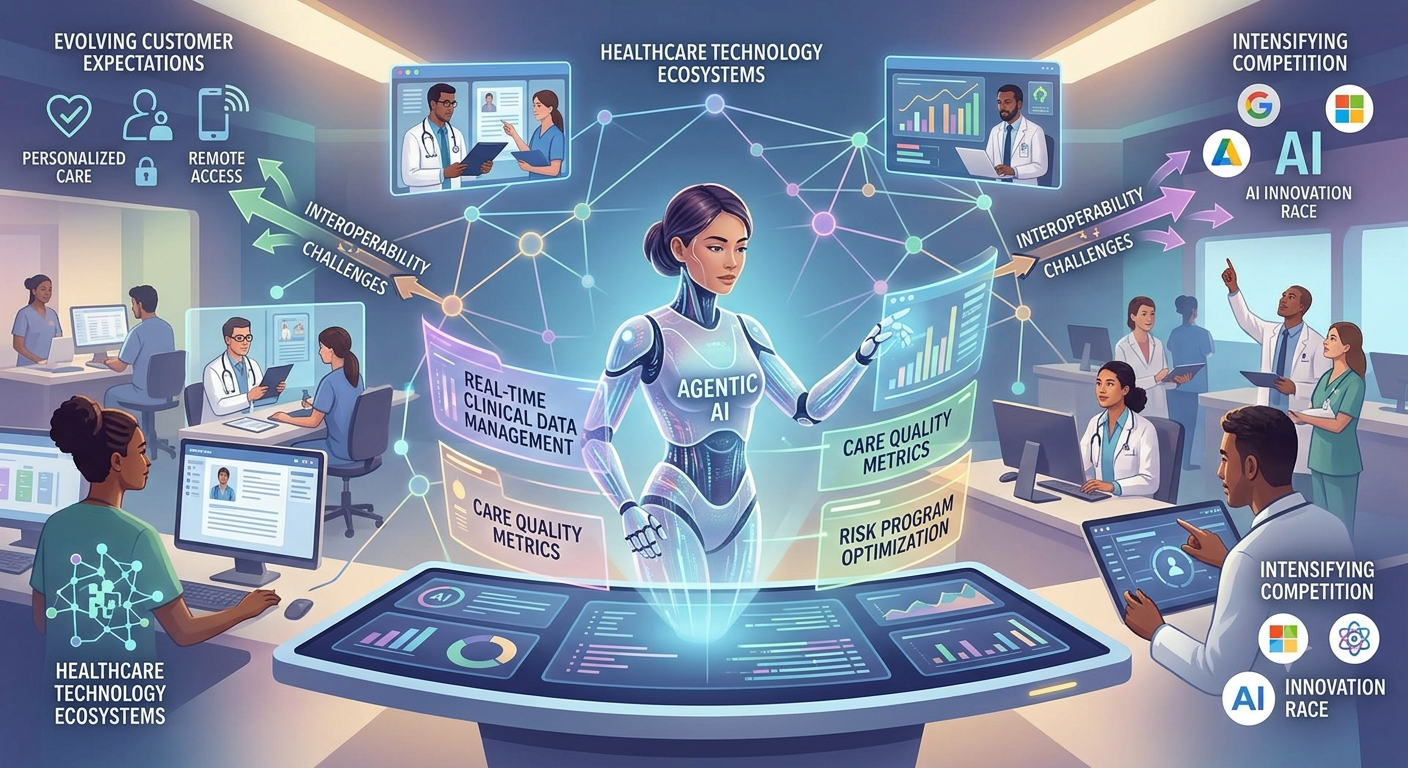
Generative AI (GenAI) and Agentic AI are reshaping the way healthcare organizations handle clinical data and risk analytics. Instead of just automating routine tasks, these technologies are powering smarter, more intuitive workflows. The result? Better data quality, faster decisions, and less administrative hassle for everyone involved.
Clinical data management
Healthcare organizations deal with a huge variety of data—from electronic health records (EHRs) and lab results to imaging, insurance claims, wearables, and doctors’ notes. A lot of this information comes in unstructured formats, making it tough to analyze and use effectively.
Here’s how generative AI is making a difference:
• Turning messy, unstructured data into useful insights—like pulling out diagnoses, medications, and social factors from doctors’ notes with natural language processing.
• Helping clinicians keep their documentation complete and consistent, while cutting down on time spent manually entering notes.
• Summarizing patient records into clear, concise histories so clinicians can get up to speed quickly on complex cases.
• Translating clinical information across different standards, like ICD-10 or FHIR, to help systems work together more smoothly.
• Spotting missing or inconsistent documentation, duplicate records, and other issues before they cause problems later on.
Risk and Quality Programs
Traditionally, programs focused on risk and quality have depended on structured claims data and looking at what’s happened in the past. AI is changing that by broadening the kinds of data we can use and making insights available much sooner.
GenAI and advanced machine learning now help with:
• Spotting patients at risk for hospitalization or worsening conditions much earlier.
• Adjusting risk more accurately by pulling together claims, clinical notes, lab results, and social factors.
• Predicting where there might be gaps in care, so preventive steps can be taken sooner.
• Forecasting healthcare costs and needed resources with greater precision.
• Detecting fraud, waste, or abuse by flagging unusual patterns across lots of different data sources.
With these advances, care teams can be more proactive and better support value-based care goals.
The evolution to Agentic AI
Agentic AI goes a step further—it doesn’t just analyze data, but can actually plan, coordinate, and carry out multi-step tasks, always with the right amount of human oversight.
For example, AI agents can:
• Review a patient’s full medical history.
• Spot missing documentation that could affect risk scores.
• Gather clinical evidence to support care decisions.
• Suggest the right coding opportunities.
• Prepare paperwork for doctors to review.
• Kick off follow-up tasks if something’s missing.Similarly, for care management, an AI agent might:
1. Identify high-risk members.
2. Prioritize them based on predicted clinical deterioration.
3. Gather relevant clinical history.
4. Recommend evidence-based interventions.
5. Schedule follow-up tasks for care managers.
6. Monitor outcomes and continuously update recommendations.
This transforms AI from a decision-support tool into an active participant in healthcare operations.
Impact on healthcare risk analytics programs
Healthcare organizations are moving away from just looking back at data and are starting to use AI for ongoing, real-time risk management.
Some of the biggest improvements include:
• Getting risk scores in near real time, instead of waiting for periodic updates.
• Bringing together all types of clinical information, whether structured or unstructured.
• Automatically finding gaps in documentation that could affect risk ratings.
• Making it easier to track quality measures, like HEDIS and Stars programs.
• Tailoring interventions for patients who need the most support.
• Cutting down on manual chart reviews and paperwork.
• Allowing clinical and coding teams to work more efficiently at scale.
What to keep in mind
Even with all these opportunities, there are important things to watch out for, such as:
• Protecting patient privacy and staying HIPAA compliant.
• Making sure AI is governed responsibly, with transparency and the ability to audit decisions.
• Carefully validating AI outputs to avoid errors and ensure clinical accuracy.
• Looking for and reducing bias in predictive models.
• Keeping humans in the loop for clinical decisions.
• Making sure new tools fit with existing EHRs and data systems.
• Staying up to date with evolving regulations around AI.
What’s next?
We’re likely to see the rise of collaborative teams of specialized AI agents in healthcare. Rather than relying on one big model to do everything, organizations might use a variety of AI agents, each focused on tasks like documentation, coding, risk adjustment, quality measurement, care coordination, or prior authorizations. These agents can work together—under clear governance—while clinicians stay in charge of critical decisions.
This marks a big shift: AI won’t just be about analyzing data, but about helping to run the entire clinical and operational workflow from end to end. The payoff? More accurate data, sharper risk predictions, smoother operations, less paperwork, and most importantly better outcomes for patients and stronger performance in value-based care.
Q3. What are the biggest barriers preventing seamless healthcare data exchange across providers, payers, and technology platforms?
Even with major investments in interoperability, sharing healthcare data smoothly is still tough. The obstacles aren’t just about technology anymore—they also involve organizational, regulatory, financial, and governance factors.
1. Different data standards, different challenges
While standards like FHIR, HL7 v2, C-CDA, and DICOM are common, every organization seems to use them a bit differently.
Some common hurdles are:
• Different interpretations of implementation guides
• Inconsistent use of clinical terminologies (ICD-10, SNOMED CT, LOINC, RxNorm)
• Proprietary extensions by vendors
• Variable data quality and completeness
So, even if two systems both say they’re FHIR-compliant, they often need extra work to actually talk to each other.
2. Older healthcare IT systems
A lot of providers still use older systems that were built mainly for their own internal processes—not for easy data sharing.
These systems typically:
• Store data in proprietary formats
• Have limited API capabilities
• Require batch-based data exchange
• Are expensive to modernize
This makes it complicated to connect hospitals, clinics, labs, pharmacies, and payers.
3. Data quality and consistency issues
Healthcare organizations often face problems like:
• Duplicate patient records
• Missing documentation
• Inconsistent coding
• Incomplete clinical histories
• Variable documentation practices among clinicians
When data quality is poor, it’s hard to trust shared information—and it makes analytics and AI less effective.
4. Matching patients to their records
There’s no universal patient ID in many healthcare systems, including the U.S.
So organizations usually rely on demographic matching, which can lead to:
• Duplicate patient records
• Incorrect matches
• Fragmented longitudinal health records
Getting patient matching right is still one of the toughest problems for interoperability.
5. Balancing privacy, security, and regulations
Sharing healthcare data means finding the right balance between making information accessible and keeping patient privacy protected.
Organizations have to juggle things like:
• HIPAA and regional privacy regulations
• Patient consent management
• Data sharing agreements
• Cybersecurity risks
• Third-party access controls
Worries about security often slow down or limit how much information gets shared.
6. When business incentives don’t line up
Even if the technology is ready, organizations aren’t always motivated to share data.
For example:
• Competitive concerns over patient retention
• Cost of integration projects
• Limited financial incentives for sharing data
• Different priorities between providers and payers
Value-based care is helping get everyone on the same page, but fee-for-service setups can still make broader collaboration difficult.
7. Making data fit into daily workflows
Even when data is available, it doesn’t always show up in a way that actually helps clinicians in their day-to-day work.
Some common issues are:
• Information overload
• Poor presentation within EHRs
• Alert fatigue
• Clinicians needing to access multiple systems
Interoperability only really works when shared information is useful right when and where it’s needed.
8. When systems don’t “speak the same language”
It’s one thing to swap data, but it’s a whole other challenge to make sure it means the same thing in different systems.
For instance:
• A diagnosis may be coded differently by two organizations.
• Laboratory values may use different units or reference ranges.
• Clinical concepts may be represented using different terminologies.
Getting everyone to agree on what the data means is crucial for reliable analytics, quality reporting, and AI.
9. Building trust and clear rules
Sharing data effectively means everyone needs to agree on the rules and trust each other.
Some challenges are:
• Data ownership questions
• Responsibility for data quality
• Access policies
• Audit requirements
• Cross-organizational trust
If these rules aren’t clear, organizations may be reluctant to trust or use data from outside sources.
10. Getting interoperability ready for AI
As healthcare starts using GenAI and Agentic AI, the bar for interoperability keeps rising.
AI systems need things like:
• High-quality longitudinal patient records
• Near real-time data availability
• Standardized clinical terminology
• Rich metadata and provenance
• Explainable and traceable data sources
If these basics aren’t solid, AI models can end up giving unreliable or incomplete results.
Looking ahead: building true interoperability
Healthcare is moving past basic data sharing and aiming for intelligent interoperability. That means systems won’t just pass along information—they’ll also understand its context and help support smarter, coordinated decisions.
Some key things that help make this possible are:
• Broader adoption of standardized APIs (such as FHIR)
• Stronger data governance and master data management
• Improved patient identity resolution
• Cloud-based interoperability platforms
• AI-assisted data normalization and terminology mapping
• Robust consent and security frameworks
• Collaborative ecosystems among providers, payers, and technology partners
As GenAI and Agentic AI evolve, organizations that build a solid foundation for interoperability will be in the best spot to automate workflows, improve risk analytics, and deliver more connected, patient-centered care.
Q4. How is technology changing the way healthcare organizations identify care gaps and improve patient outcomes?
Technology is changing the way healthcare organizations find and address care gaps—moving from looking back at what happened to taking action sooner with data-driven approaches. Thanks to advances in cloud computing, better data sharing, AI, and real-time analytics, providers and payers can spot issues earlier, focus on high-risk patients, and offer more personalized care.
1. Bringing together the whole patient story
Healthcare organizations are combining information from electronic health records (EHRs), insurance claims, labs, pharmacies, wearables, and even social factors to get a fuller picture of each patient.
Having this ongoing view of patient data helps clinicians:
• Spot missed screenings or vaccinations
• Notice if patients aren’t sticking with their medications
• Track how chronic conditions are progressing
• Understand the non-medical factors that can impact someone’s health
2. How AI helps spot care gaps
Instead of relying only on set business rules, today’s AI and machine learning can sift through huge amounts of both structured and unstructured data to find patients who might need extra attention.
For example, AI can:
• Predict which patients are at high risk of being hospitalized or readmitted
• Find chronic health issues that haven’t been documented but could affect care
• Spot preventive services that were missed
• Recommend treatments based on the latest evidence
• Prioritize patients by their actual health risks instead of just how often they use services
Generative AI can also summarize patient histories and pull out key clinical details from doctors’ notes, so there’s less need for manual chart reviews.
3. Delivering real-time support to clinicians
Modern clinical systems now give clinicians useful information right when they’re seeing a patient, not just after the visit is over.
This can look like:
• Alerts for overdue screenings or vaccines
• Recommendations to help with medication safety and sticking to treatment
• Suggestions for treatment paths based on the latest research
• Pointing out opportunities to meet quality measures while the patient is in the office
By weaving these insights into daily clinical routines, providers can address care gaps while the patient is right there in the office or clinic.
4. Helping value-based care work better
Technology is key to value-based care. It helps organizations track quality measures, manage the health of whole populations, and improve results—all while keeping an eye on costs.
Analytics platforms can:
• Sort patients by risk level
• Keep tabs on quality measures like HEDIS
• Spot patients whose risk is rising
• Help care teams decide who to focus on
• Track how provider networks are performing
This means care teams can put their time and resources where they’ll do the most good.
5. Making care coordination smoother
With better data sharing technologies and standardized APIs, everyone from providers and specialists to hospitals and insurers can exchange clinical information more easily.
This better coordination helps cut down on:
• Repeated (and unnecessary) tests
• Delays in follow-up care
• Medication mix-ups
• Missed specialist referrals
• Gaps in the patient’s experience
Having the full story on a patient’s journey makes it easier for them to move smoothly between different types of care.
6. Helping patients play a bigger role in their care
Digital health tools are helping patients get more involved in their own care through:
• Patient portals
• Mobile health apps
• Remote monitoring
• Wearables
• Automated reminders for meds and checkups
• Telehealth visits
These tools help people stick to their care plans and catch problems before they get out of hand.
7. Using Agentic AI to streamline care management
Agentic AI goes beyond just offering insights—it can coordinate multi-step tasks, still making sure that people are guiding the process.
For instance, an AI agent can:
• Identify a patient with an open care gap.
• Review clinical records and recent laboratory results.
• Verify eligibility for a recommended intervention.
• Notify the care management team.
• Draft patient outreach communications.
• Schedule follow-up activities.
• Track whether the care gap has been closed.
This lightens the load for care managers, so they can focus on patients who need more hands-on support.
What challenges still remain?
For these benefits to really pay off, organizations need to keep working on:
• Data quality and sharing
• Strong privacy and security
• Clear AI governance and transparency
• Making sure tools fit into clinicians’ daily routines
• Validating that AI recommendations are sound
• Watching for equity and bias issues
All of these are key to making sure technology actually improves care—without creating new problems.
What’s next for care gap management?
The future of care gap management is all about being predictive and personal. Instead of just finding missed services after the fact, more organizations are using AI, better data platforms, and smart automation to anticipate patients’ needs and recommend care right when it matters.
This shift lets providers and payers move from reacting to problems to managing the health of whole populations—boosting quality, helping patients stay engaged, and supporting value-based care that lasts.
Q5. How is the competitive landscape evolving among healthcare technology companies, cloud providers, analytics vendors, and AI-native startups?
AI is quickly reshaping the healthcare technology landscape. The lines between healthcare software vendors, cloud providers, analytics companies, and AI startups are fading. Organizations now compete not just on what their software can do, but on how well they deliver interoperable, AI-powered platforms that improve care, streamline operations, and make a real difference to the bottom line.
1. Healthcare technology companies are turning into AI platform providers
Established healthcare tech companies are now building AI right into their core products, instead of treating it as a separate add-on.
Key areas of investment include:
• Ambient clinical documentation
• Clinical decision support
• Revenue cycle automation
• Population health management
• Risk adjustment
• Prior authorization automation
• Care management workflows
Their edge comes from deeply understanding healthcare workflows, having lots of existing customers, and access to valuable clinical data.
2. Cloud providers are powering healthcare innovation
Big cloud providers are doing more than just offering infrastructure—they’re rolling out healthcare-specific AI and data solutions.
They provide:
• Secure, scalable healthcare data platforms
• FHIR-native interoperability services
• AI development environments
• Large language model (LLM) infrastructure
• Data lakes and real-time analytics
• Healthcare-specific security and compliance capabilities
Their strength? Letting healthcare organizations build AI solutions without the headache of managing complex tech, and helping different systems work together.
3. Analytics vendors are becoming smart decision platforms
Analytics companies are moving beyond basic dashboards toward tools that predict what’s coming—and even recommend what to do next.
Modern platforms increasingly offer:
• Predictive risk modeling
• Population health insights
• Quality measurement automation
• Clinical and financial forecasting
• AI-assisted exploration of healthcare data
• Natural language querying of analytics
The goal is to help organizations not just understand the past, but actually decide what to do next.
4. AI-first startups are shaking up the industry
AI-native startups are introducing focused solutions that address specific healthcare challenges, such as:
• Clinical documentation automation
• Medical coding and risk adjustment
• Prior authorization
• Clinical trial matching
• Patient engagement
• Care navigation
• Provider productivity
Because they don’t have old systems to worry about, these startups move fast and can quickly try out the latest AI advances. Their main hurdles? Proving their solutions work in the real world, fitting into existing workflows, and scaling up in a highly regulated field.
5. Competition is moving toward connected ecosystems
Healthcare organizations increasingly prefer platforms that combine:
• Interoperability
• AI capabilities
• Analytics
• Workflow automation
• Security and compliance
Because of this, vendors are teaming up, acquiring other companies, and embracing open APIs to build bigger, more connected ecosystems—instead of just selling stand-alone products.
6. Data is now a real competitive advantage
Increasingly, having access to high-quality healthcare data is what sets organizations apart.
Organizations with:
• Longitudinal patient records
• High-quality clinical documentation
• Claims data
• Social determinants of health
• Imaging and genomic data
can build more accurate AI models and offer truly personalized insights. But to succeed, they need strong governance, solid privacy protections, and to use data responsibly.
7. Agentic AI is shaping the next wave of competition
Beyond Generative AI, many organizations are exploring Agentic AI—systems capable of planning and coordinating multi-step workflows under human oversight.
Potential applications include:
• Coordinating care management activities
• Automating prior authorization workflows
• Identifying and closing care gaps
• Supporting risk adjustment documentation
• Monitoring quality measures
• Streamlining revenue cycle operations
Being able to coordinate entire workflows could soon set leaders apart, as healthcare organizations look for bigger efficiency gains.
8. Trust, governance, and clinical validation matter more than ever
Healthcare organizations expect AI solutions to be:
• Transparent and explainable
• Clinically validated
• Secure and compliant
• Fair and unbiased
• Seamlessly integrated into clinician workflows
Vendors who can show real improvements in outcomes, efficiency, and compliance are the ones most likely to stand out.
What does all this mean for healthcare organizations?
As the market changes, healthcare organizations are moving away from buying one-off apps. Instead, they’re looking for strategic platforms and true partners. More and more, they judge vendors on whether they can:
• Connect across the whole healthcare ecosystem
• Help with value-based care
• Support responsible, practical AI adoption
• Deliver real results—both clinical and operational
• Scale up securely across the enterprise
Those likely to succeed will have deep healthcare know-how, platforms that play well with others, advanced AI, and strong governance. The future isn’t about AI replacing current healthcare tech—it’s about building smart ecosystems where cloud, software, analytics, and AI all work together to support clinicians, administrators, and patients at every step of the care journey.
Q6. How are customer expectations evolving regarding healthcare software platforms and data-driven solutions?
Customer expectations for healthcare software are changing fast as the industry moves from just digitizing records to making systems smarter. Providers, payers, and life sciences companies now want more than just features—they’re looking for platforms that actually improve outcomes, boost efficiency, and fit right into the way people already work.
1. Less about features, more about results
Healthcare organizations are asking their technology partners to show real business value—not just a list of features.
They want to know things like:
• Will this help patients get better?
• How much paperwork will it cut out?
• Will it lower the overall cost of care?
• Can it help boost quality scores and risk adjustment?
• What’s the real, measurable return on investment (ROI)?
Success is measured by things like fewer readmissions, higher quality scores, quicker prior authorizations, and helping clinicians be more productive.
2. AI is now a must-have, not a nice-to-have
Generative AI isn’t just a buzzword anymore—it’s something customers expect as a standard part of the platform. They want AI built right into daily workflows, not tacked on as an afterthought.
They expect platforms to:
• Summarize patient histories
• Assist with clinical documentation
• Identify care gaps
• Predict patient risk
• Automate repetitive administrative tasks
• Generate actionable recommendations with appropriate human oversight
The focus is on AI that helps healthcare professionals and fits naturally into how they already work.
3. Seamless data sharing is non-negotiable
Healthcare organizations expect software to share data easily, without a lot of extra setup or workarounds.
Key expectations include:
• Standards-based APIs (such as FHIR)
• Integration with EHRs, payer systems, and ancillary applications
• Real-time data exchange
• Reduced dependence on point-to-point interfaces
• Consistent patient data across the care continuum
Being able to connect and share information is now a must, not just a nice bonus.
4. Automation that makes work easier
More and more, customers want platforms that don’t just give insights—they actually help get things done.
Examples include:
• Coordinating prior authorization processes
• Managing referrals
• Supporting care management outreach
• Closing quality and care gaps
• Streamlining revenue cycle activities
This shows a growing demand for smart automation and Agentic AI that can handle routine work but still keeps people in control.
5. Personalized experiences for every role
Healthcare organizations know that everyone—clinicians, care managers, executives, and patients—needs different information to do their jobs well.
Customers expect:
• Role-based dashboards
• Personalized recommendations
• Context-aware alerts
• Natural language search and conversational interfaces
• Tailored patient engagement experiences
The goal: get the right info to the right person at just the right moment.
6. Quick setup and room to grow
Organizations want flexible cloud platforms that can keep up with changing rules, payment models, and priorities.
Desired characteristics include:
• Rapid deployment
• Low-code or configurable workflows
• Modular architecture
• Frequent feature updates
• Scalable cloud infrastructure
Customers want fresh ideas and features—without waiting forever for them to go live.
7. Trust and transparency in AI matter more than ever
As AI becomes more common, organizations care more about using it responsibly.
They expect:
• Explainable recommendations
• Clinical validation
• Auditability
• Bias monitoring
• Strong governance
• Compliance with privacy and security regulations
Trust matters just as much as technical smarts—especially when AI is used for clinical or financial decisions.
8. Data isn’t just for reports—it’s a game-changer
Healthcare organizations now see data as the backbone for making better decisions and driving new ideas—not just something for the reports.
They expect platforms to:
• Integrate structured and unstructured data
• Deliver near real-time analytics
• Support predictive and prescriptive insights
• Enable population health management
• Provide actionable intelligence rather than static reports
The mindset has changed from “just show me the data” to “help me figure out what to do next.”
9. Looking for real partners, not just vendors
Customers want long-term partners, not just someone to sell them software. They value companies that:
• Understand the ins and outs of healthcare rules and workflows
• Bring real expertise as well as technology
• Help teams manage change and actually use the software
• Keep improving based on feedback
• Share responsibility for real results
Collaboration is key—especially as organizations tackle value-based care, new tech, and changing payment models.
What’s next?
As AI keeps getting better, customer expectations will keep rising. Healthcare organizations will want platforms that bring together data sharing, smart analytics, automation, and trustworthy AI all in one seamless experience.
The real differentiator will be turning all that healthcare data into insights people can actually use—insights that help patients, cut down on admin headaches, and make value-based care work. Vendors who can show real, measurable results—while staying secure, open, and easy to fit into daily work—will come out ahead as customer expectations keep evolving.
Q7. If you were an investor looking at companies within the space, what critical question would you pose to their senior management?
If I were looking at healthcare technology companies from an investor’s perspective, I’d care less about whether they simply have AI and more about how they turn those capabilities into real, lasting advantages and clear value for customers. Here are the questions I’d want to ask leadership:
1. What results are your customers actually seeing?
Beyond just listing product features, I’d want proof that your platform really moves the needle.
Examples include:
• Reduced administrative costs
• Improved clinical quality measures
• Higher risk adjustment accuracy
• Faster prior authorizations
• Reduced readmissions
• Improved clinician productivity
• ROI and customer retention
Why it matters: Long-term growth only comes from showing real-world results for your customers—not just ticking the AI box.
2. What truly sets you apart—and can you keep it?
Let’s face it, every healthcare tech company now says they use AI.
I’d ask:
• What differentiates your platform?
• Is your advantage proprietary data, clinical workflows, domain expertise, intellectual property, customer relationships, or network effects?
• How difficult would it be for a competitor to replicate your offering?
Why it matters: AI itself is becoming a commodity. What really counts are things like healthcare know-how, trusted customer relationships, and unique data.
3. How rock-solid is your data game?
In healthcare, your AI is only as good as the data behind it.
I’d want to understand:
• Data quality and governance
• Interoperability capabilities
• Access to longitudinal clinical data
• Data provenance
• Privacy and security controls
Why it matters: Great data is what gives you an edge that lasts.
4. How is AI actually changing your business?
AI isn’t just about adding new features—it can reshape your whole business.
I’d ask:
• Does AI increase revenue per customer?
• Does it reduce implementation costs?
• Does it improve customer retention?
• Can it support usage-based or outcome-based pricing?
• How does it affect gross margins?
Why it matters: At the end of the day, investors want to see how AI turns into real, sustainable financial results.
5. Are you ready for the next wave: Agentic AI?
A lot of companies are rolling out GenAI now, but the real game-changer is Agentic AI—systems that can help run complex processes, with people still in the loop.
I’d ask:
• What is your roadmap for workflow automation?
• Which operational processes can AI orchestrate?
• How do you ensure governance and human oversight?
Why it matters: Moving from AI that just gives insights to AI that actually helps get things done could be a major edge.
6. How do you make sure people trust your AI?
In healthcare, there’s not much room for mistakes.
I’d ask about:
• Clinical validation
• Explainability
• Bias monitoring
• Regulatory compliance
• AI governance
• Human-in-the-loop controls
Why it matters: In a heavily regulated field, trust isn’t optional—it can set you apart.
7. Can your platform really scale across all of healthcare?
I’d want to understand:
• Provider adoption
• Payer adoption
• Cloud strategy
• API maturity
• International expansion
• Integration with major EHR platforms
Why it matters: If your platform can scale and connect everywhere, you have a much bigger runway for growth.
8. How resilient is your business when things get tough?
I’d explore:
• Customer concentration
• Renewal rates
• Competitive threats
• Sales cycle length
• Regulatory exposure
• Dependence on specific AI model providers or cloud vendors
Why it matters: Solid fundamentals are what keep you growing for the long haul.
If I could only ask one thing, it would be this:
“Five years from now, what will make your company absolutely essential to healthcare organizations—and why will customers stick with you as AI becomes part of everyone’s toolkit?”
This question gets right to the company’s real vision and long-term game plan. It shows whether leaders see AI as just another feature or as part of a bigger plan to transform healthcare.
The best answers will blend deep healthcare knowledge, unique data, seamless data sharing, responsible AI, and a clear record of improving outcomes. That’s what will create real, lasting value for both customers and investors.
Need an expert in this space?
Talk to an Industry Expert
Knowledge Ridge connects decision-makers with carefully vetted subject matter experts for one-on-one calls, research sprints, and advisory engagements — across 11 sectors and 163 sub-industries globally.
Comments
No comments yet. Be the first to comment!